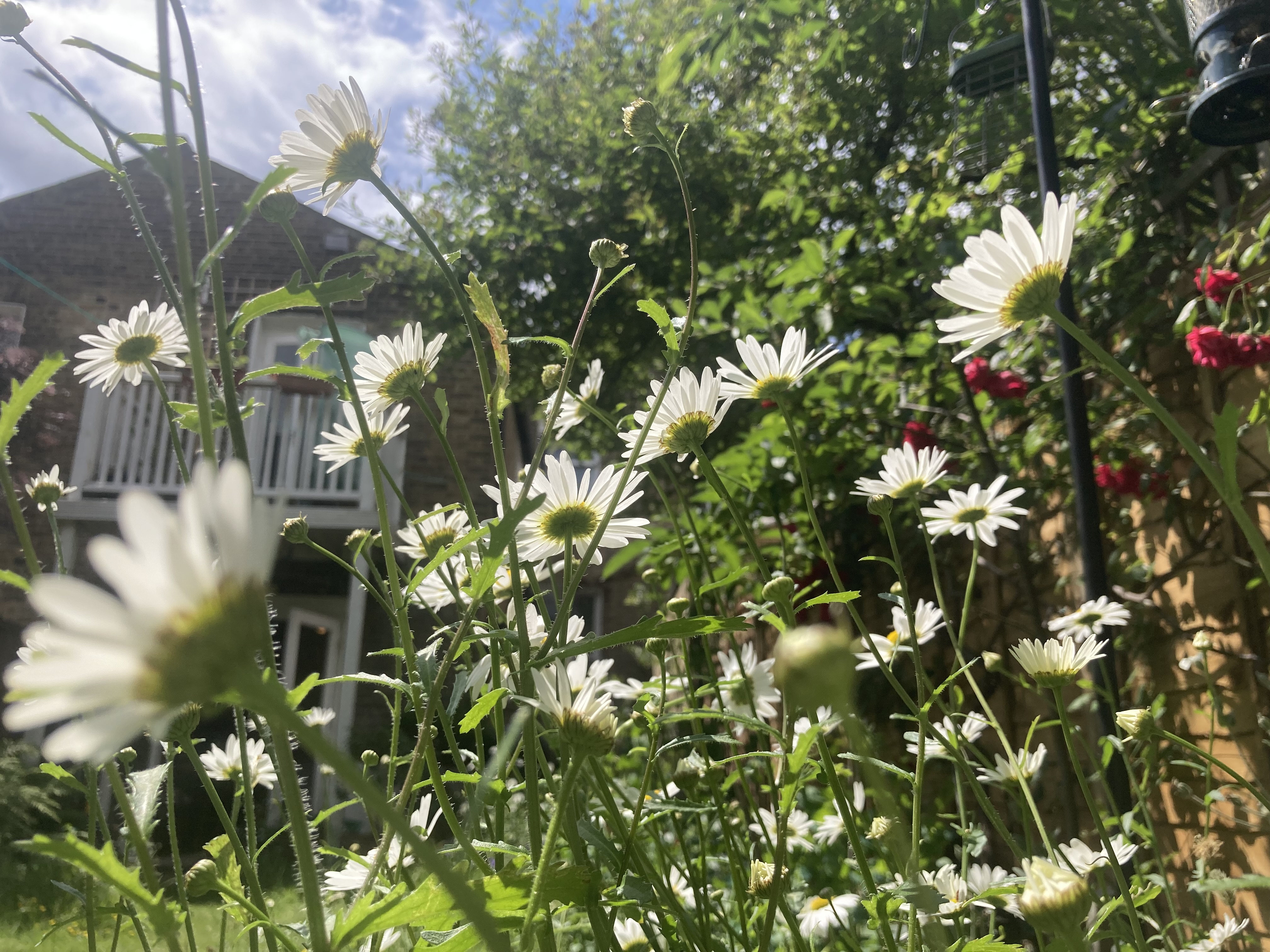
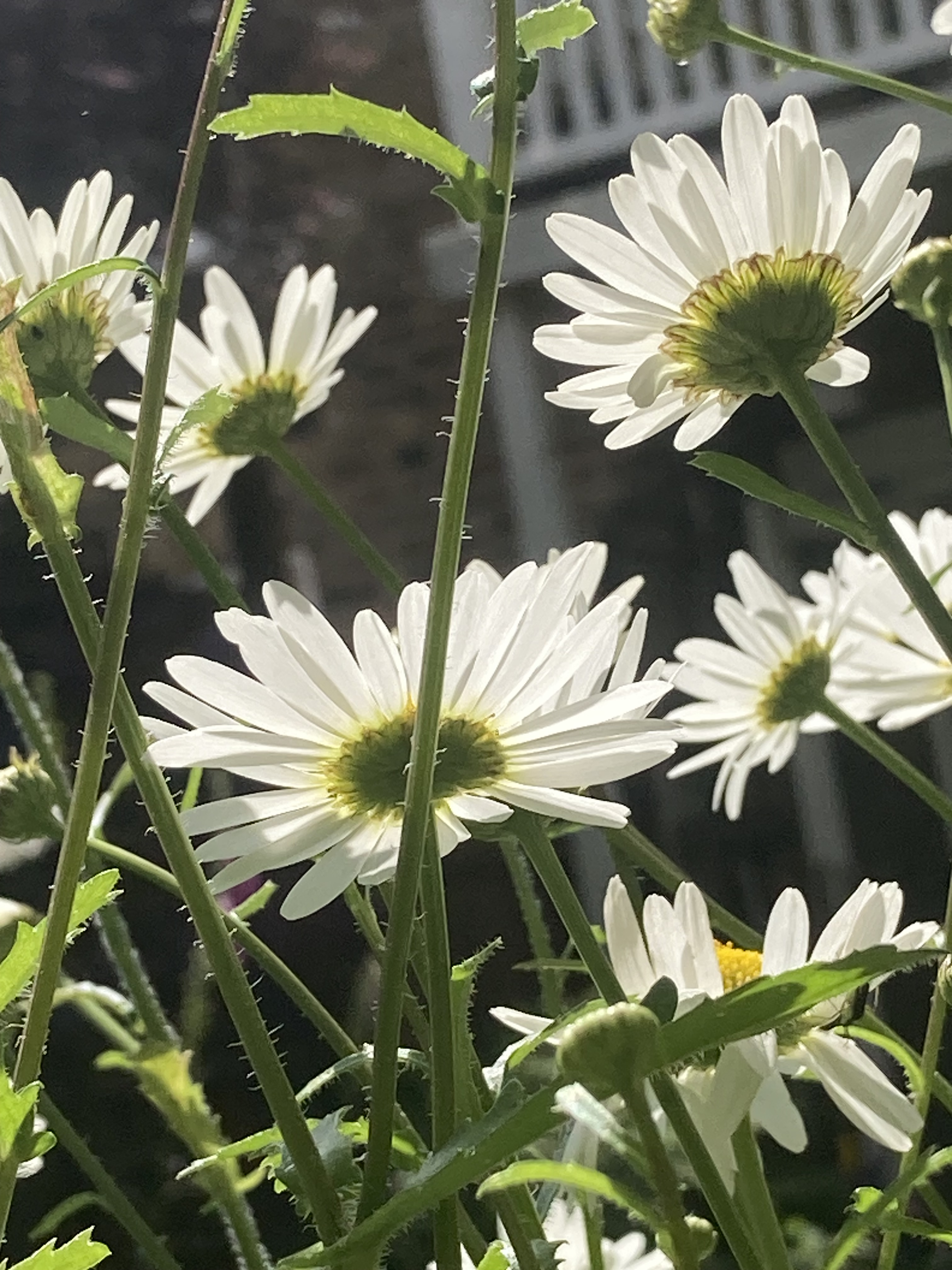
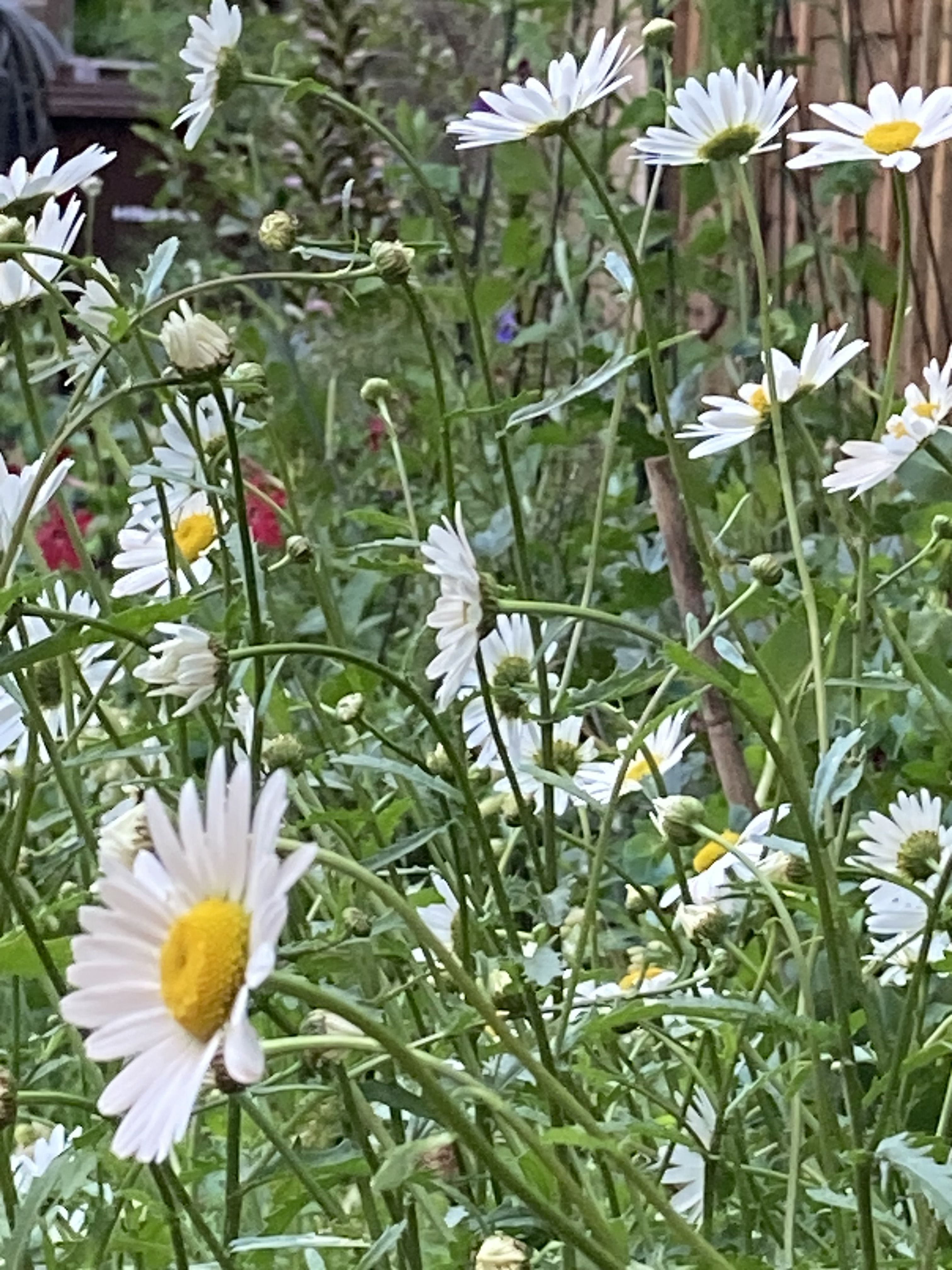
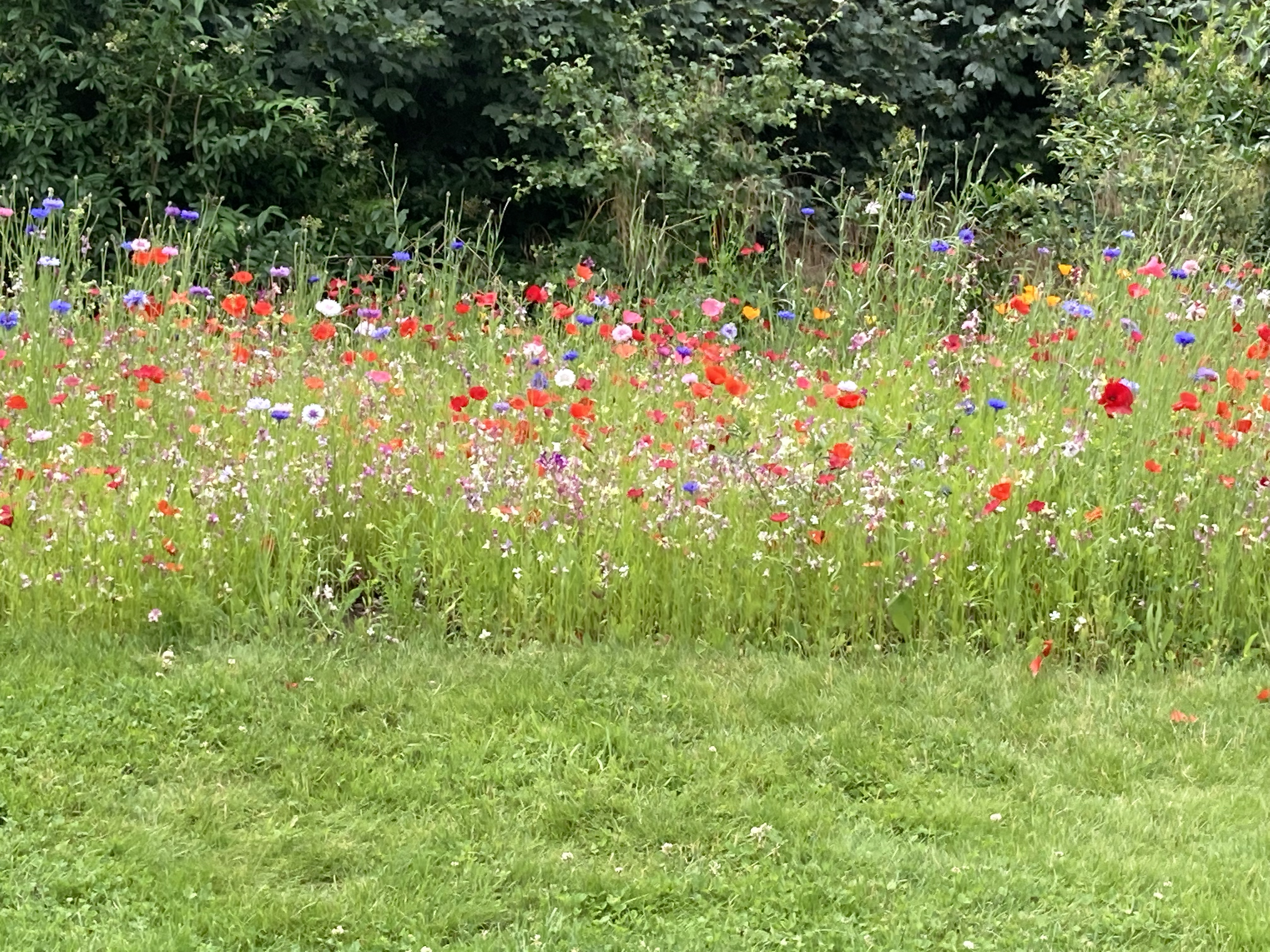
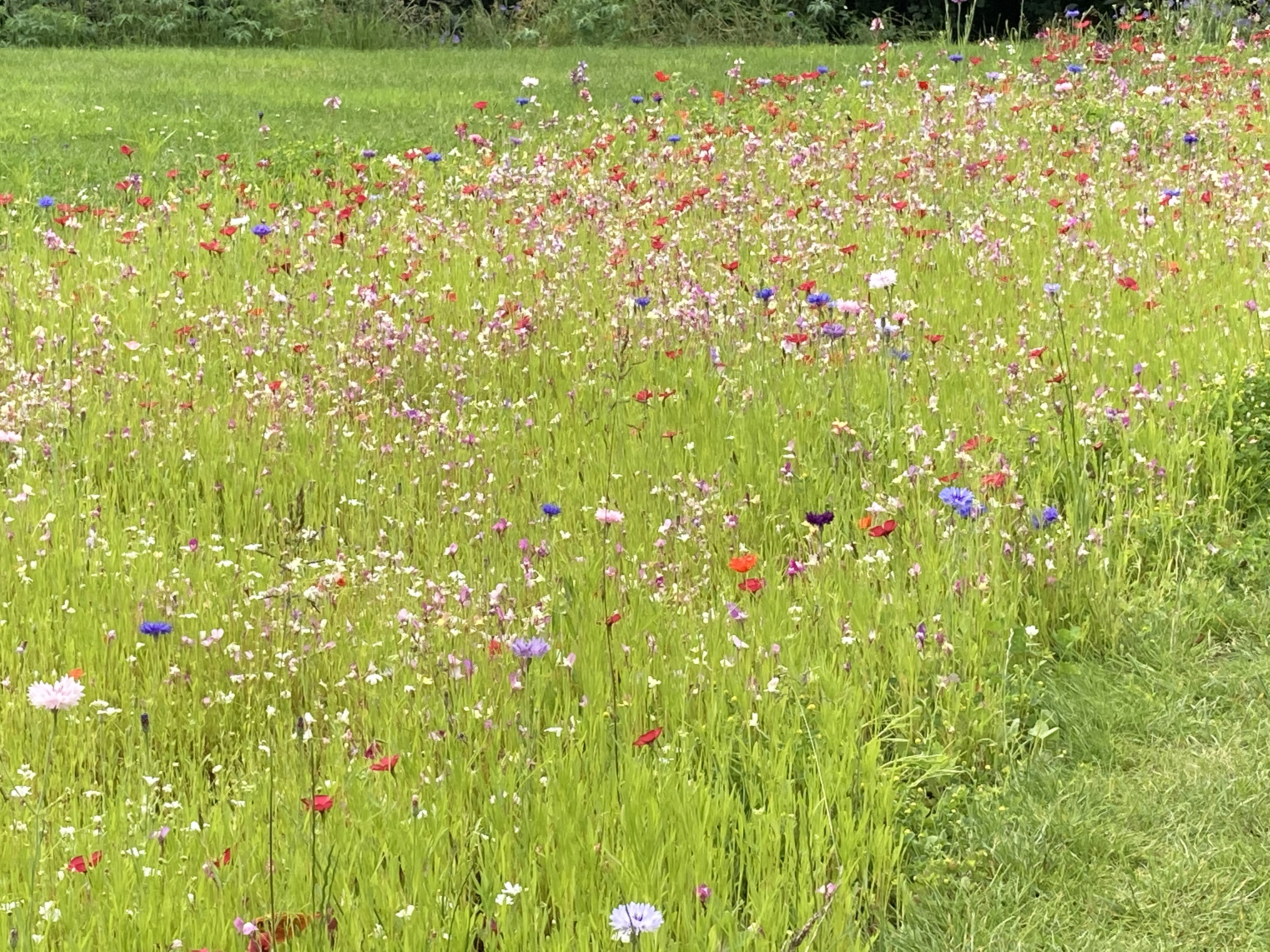
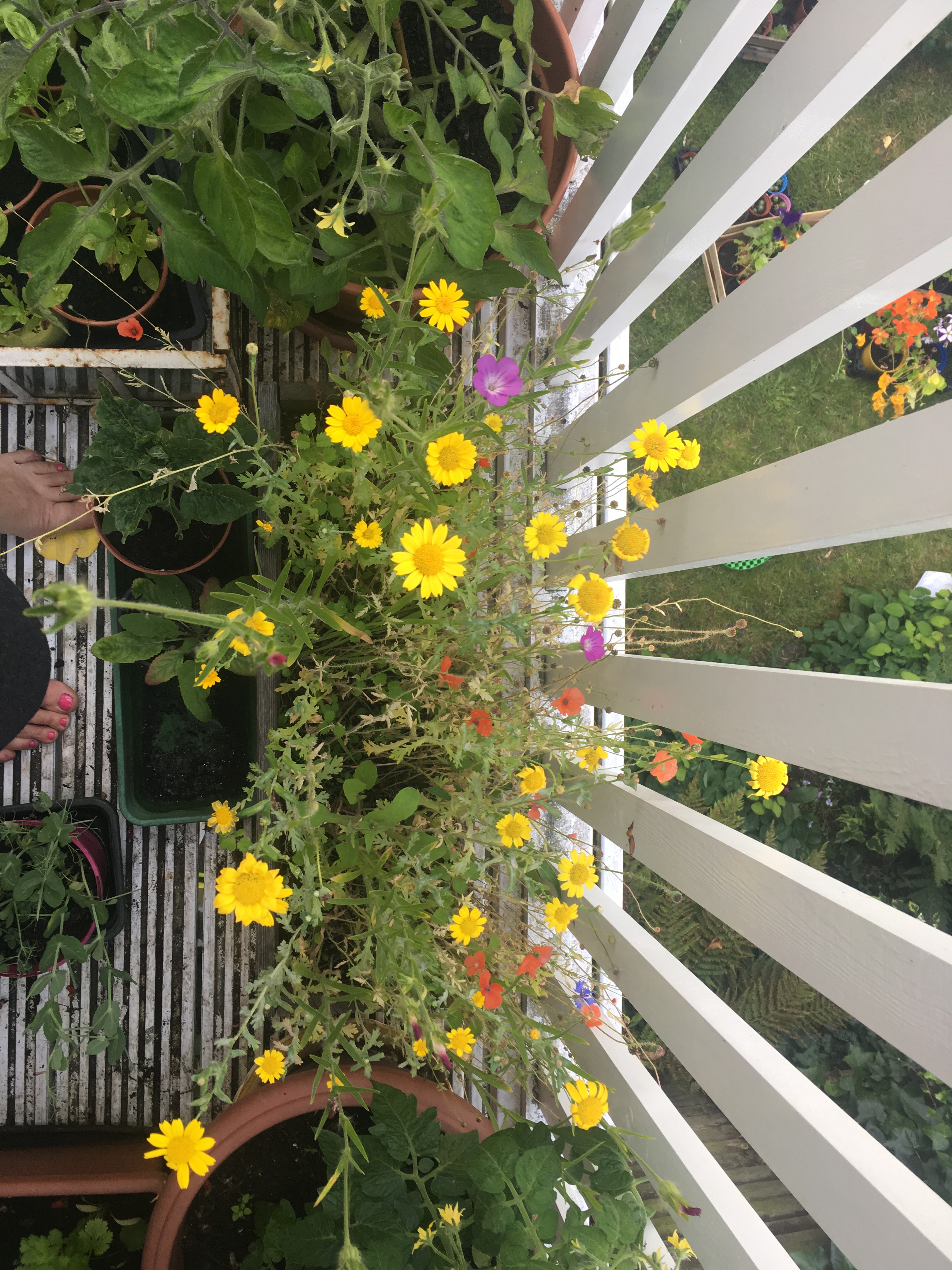
I’m not sure about ox-eye daises. I looked for other things to own this week but then I realised, it’s really their’s. They ARE weeds. Lovely weeds but ones that take over my garden, and that seed all over the front of the beds so you can’t see anything behind them, and then aren’t that lovely when not in flower. But this week, what’s not to love…
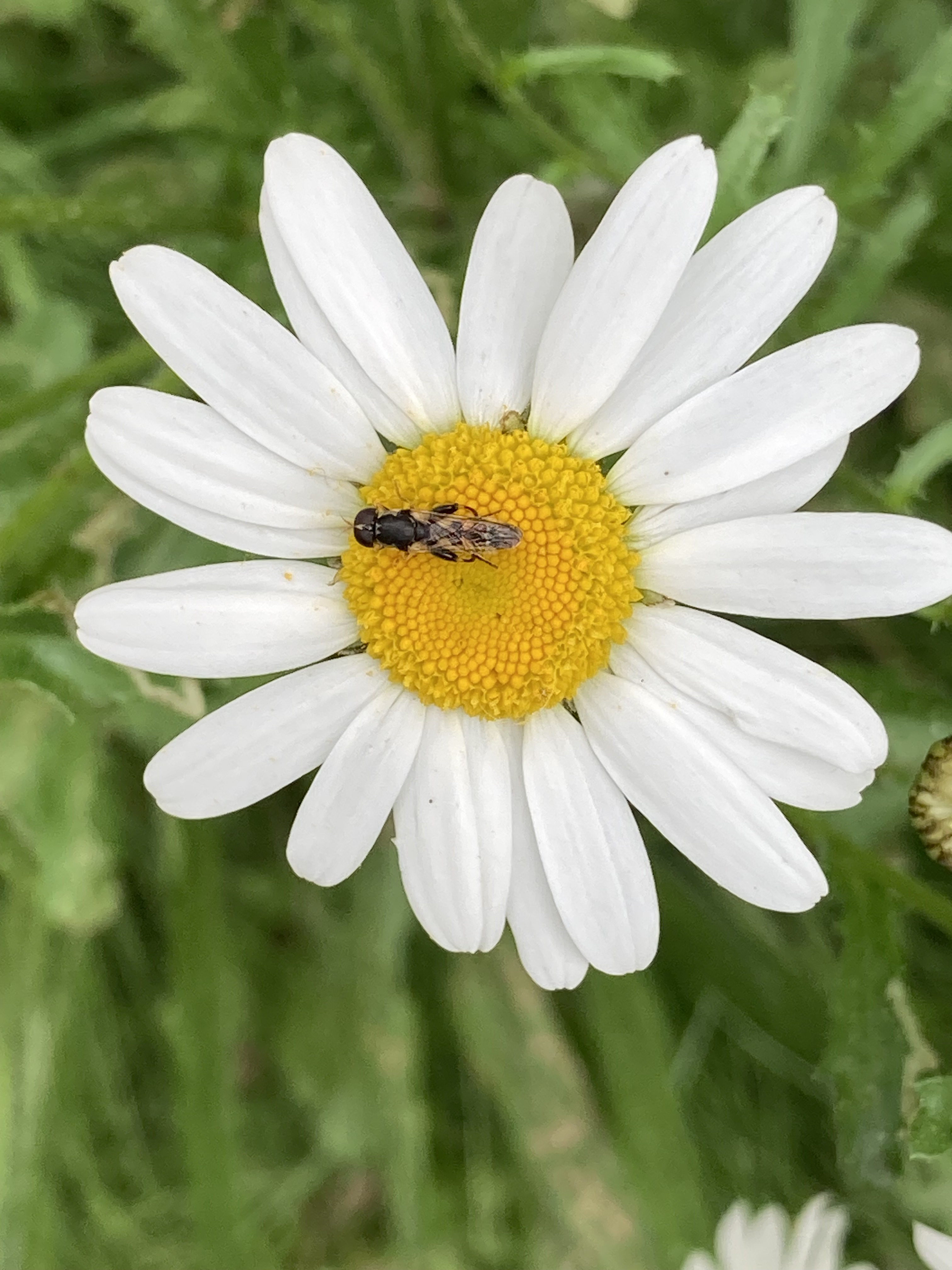
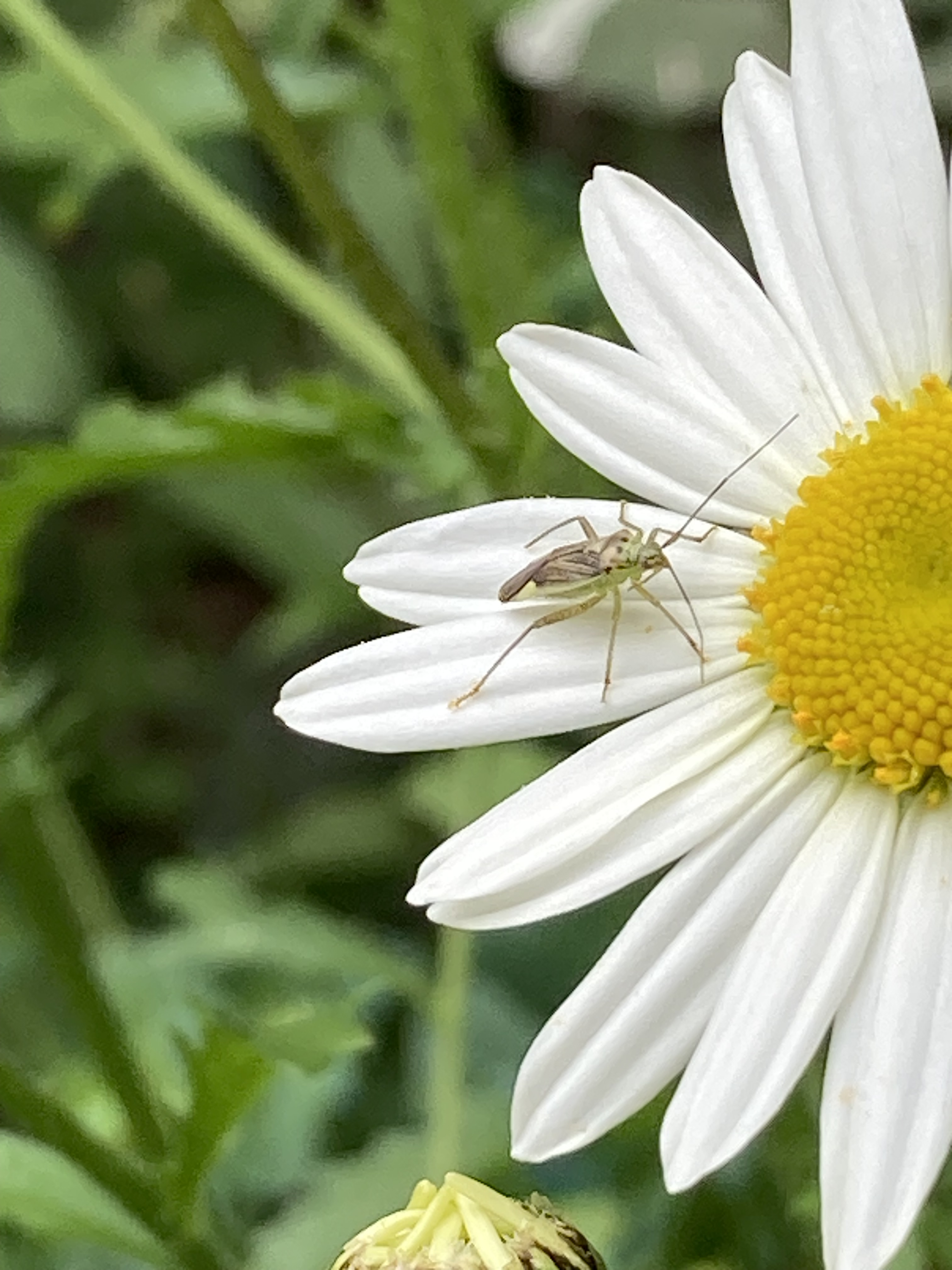
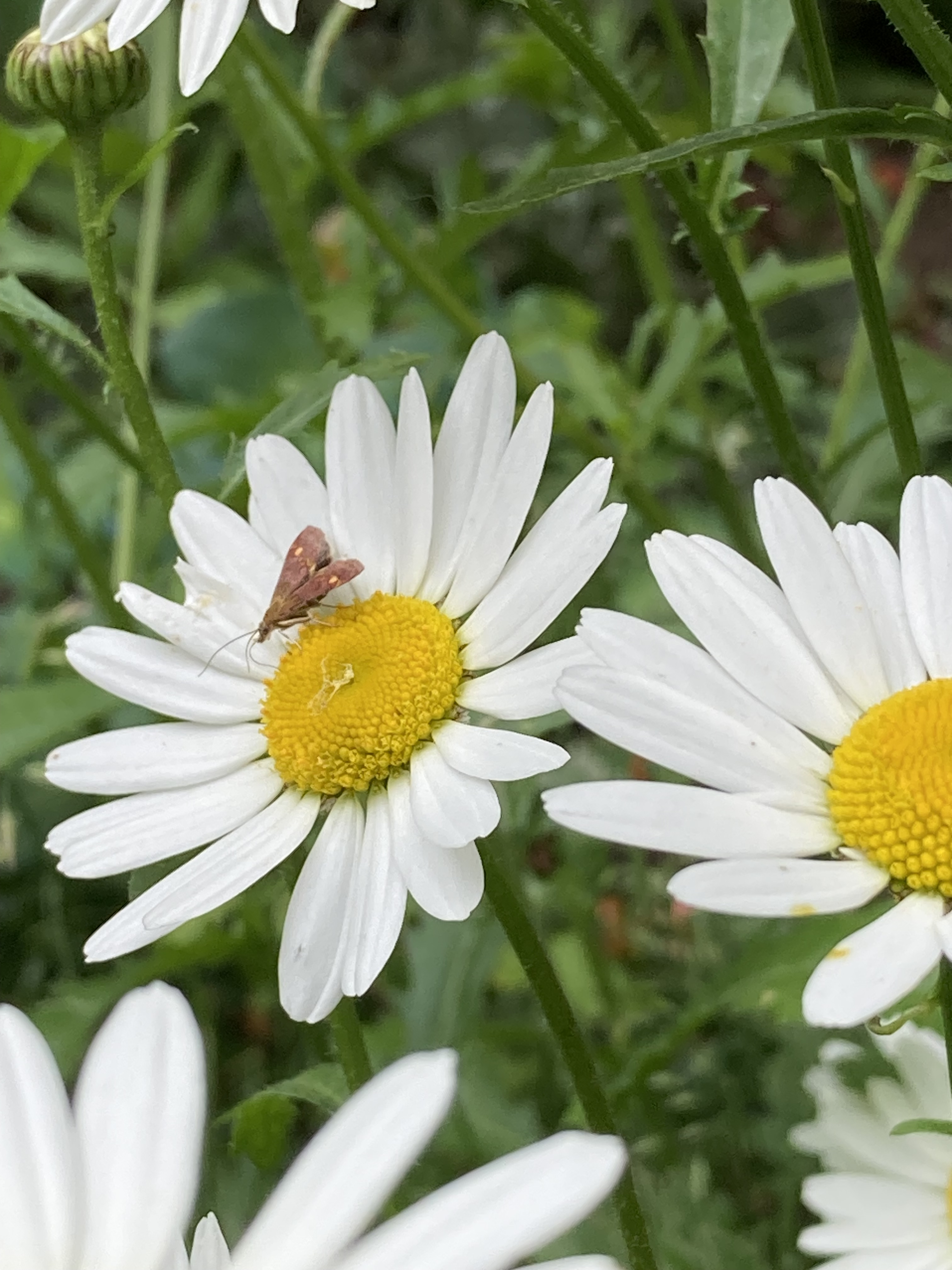
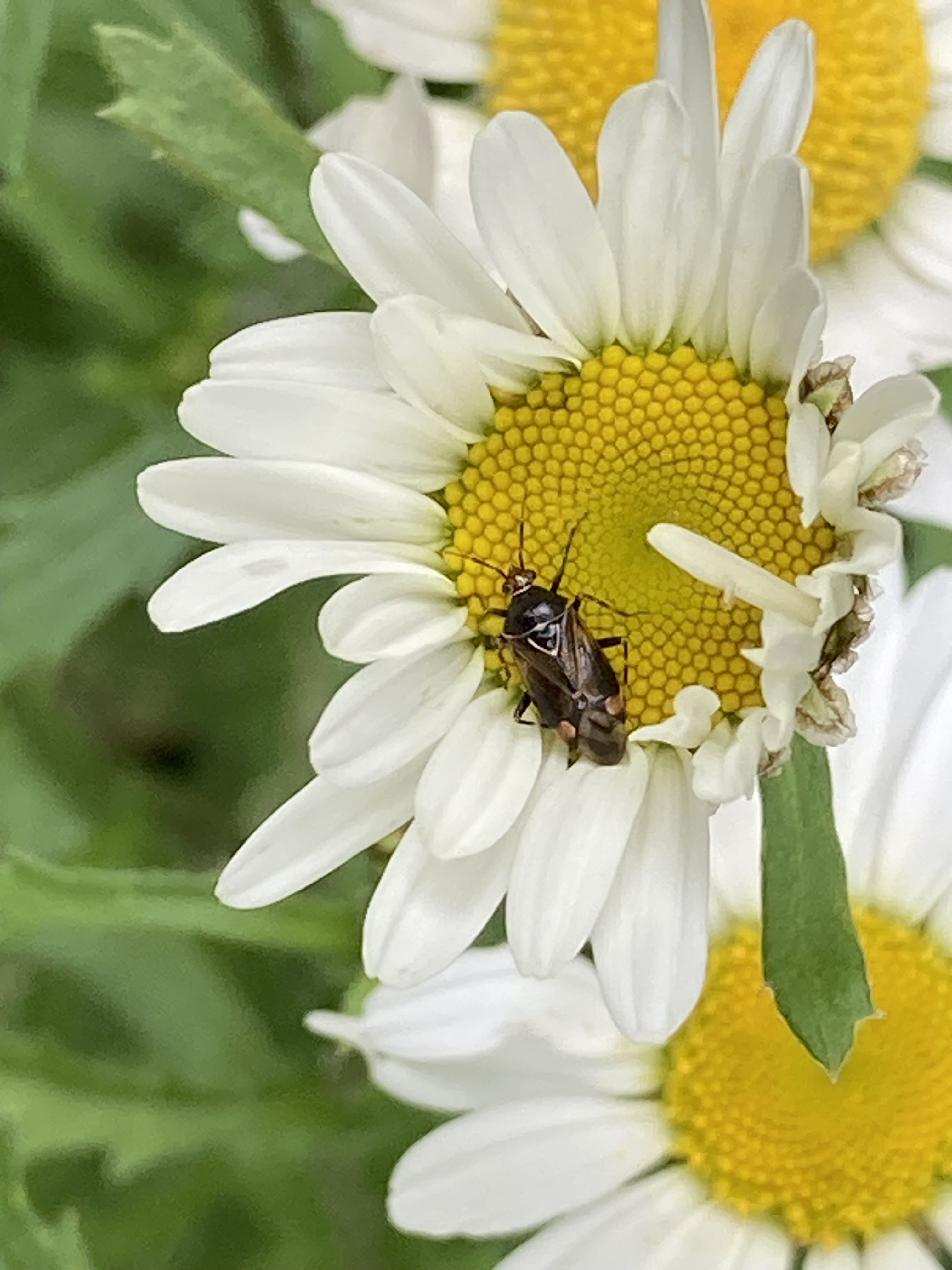
And whenever I think about ruthlessly chopping them all down (and I did chop down a lot), I see how many insects love them too.
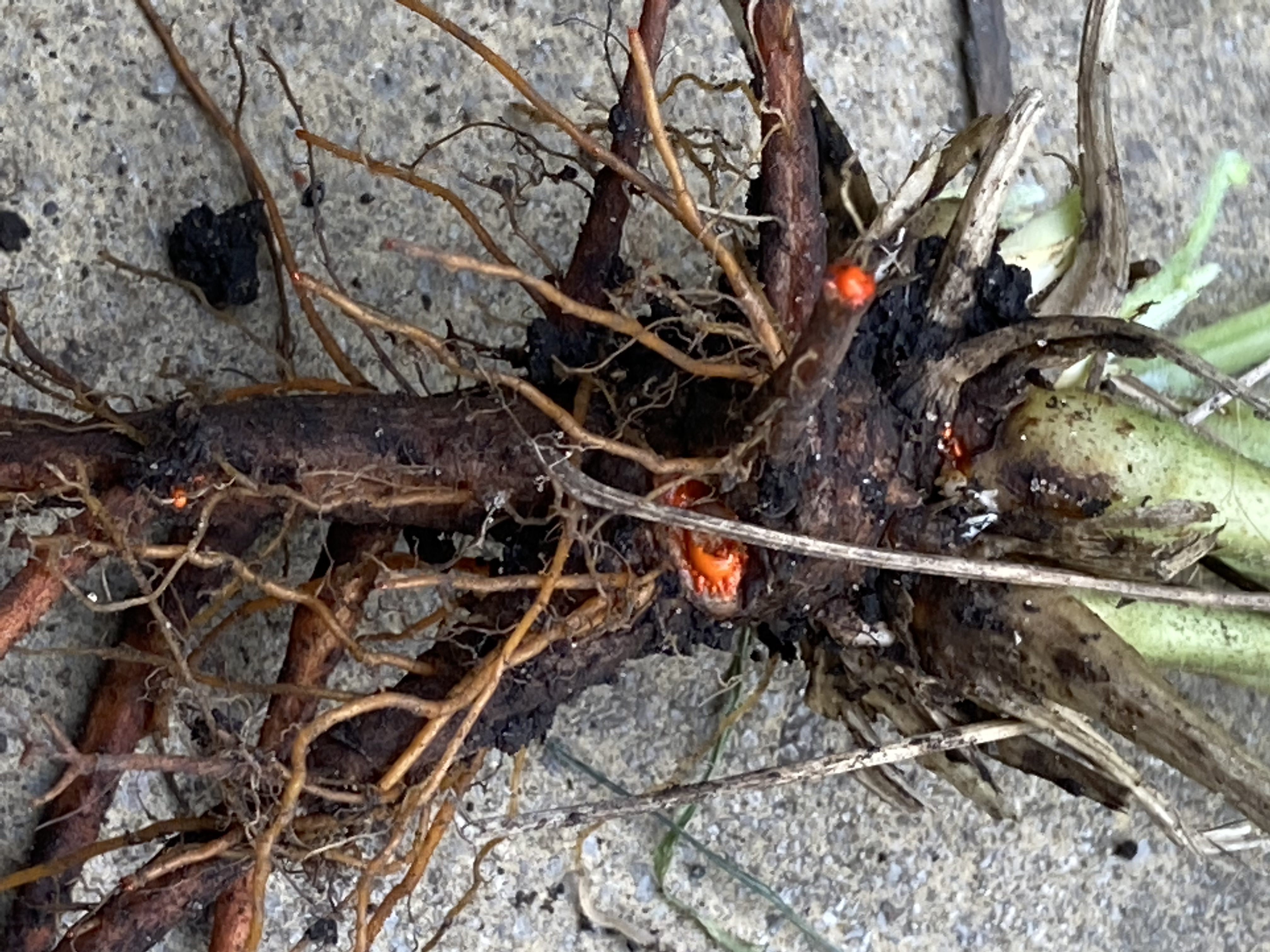
I’ve had quite a lot of this. Apparently it’s also called swallow wort, because it appears when the swallows come. And it’s called Chelidonium Major, which derives from the word for Swallow in Greek. It’s good for wildlife – but it has spread quite a lot in my garden so I pulled some up yesterday and the sap is bright orange/ red. Most Impressive.
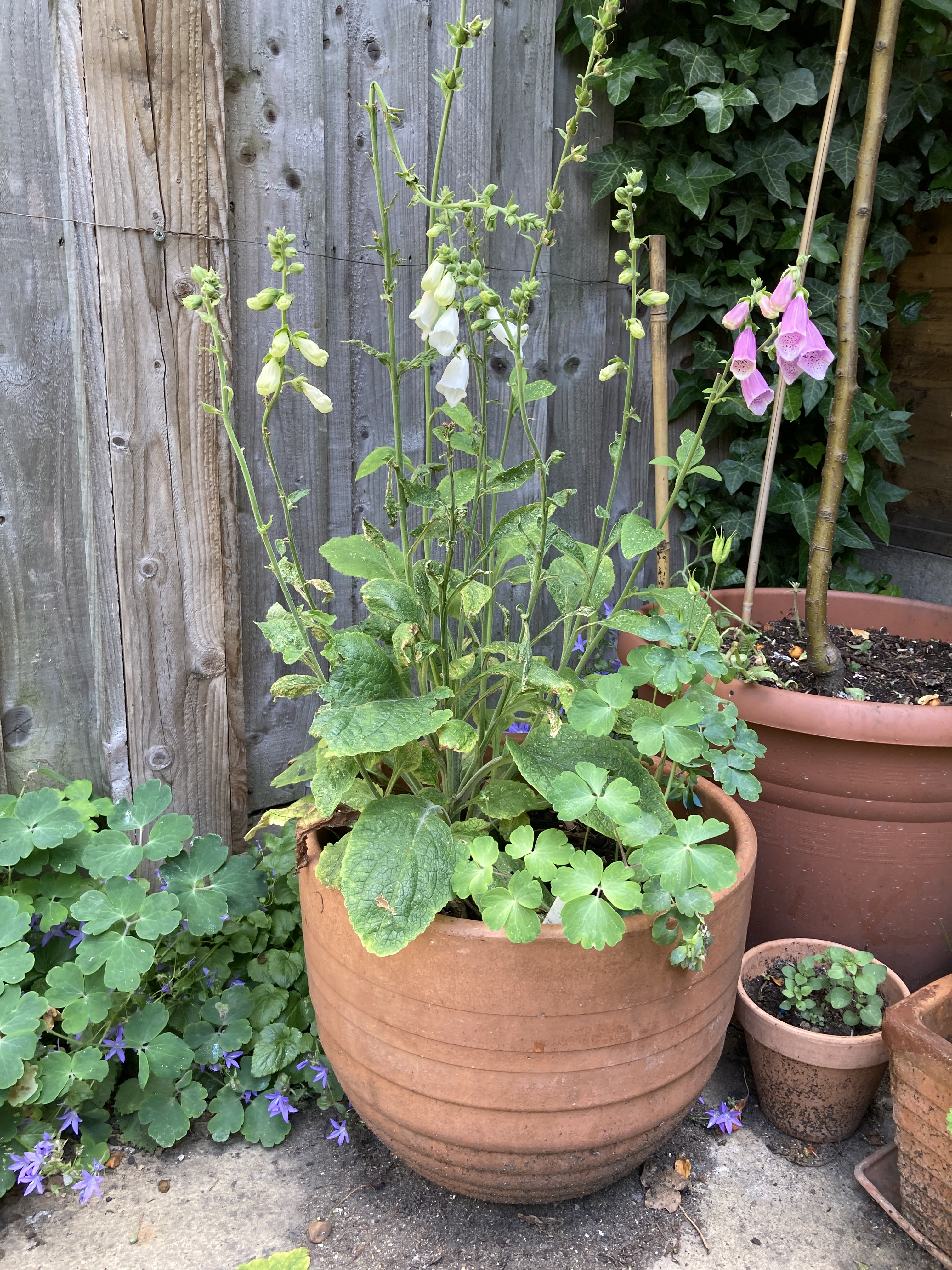
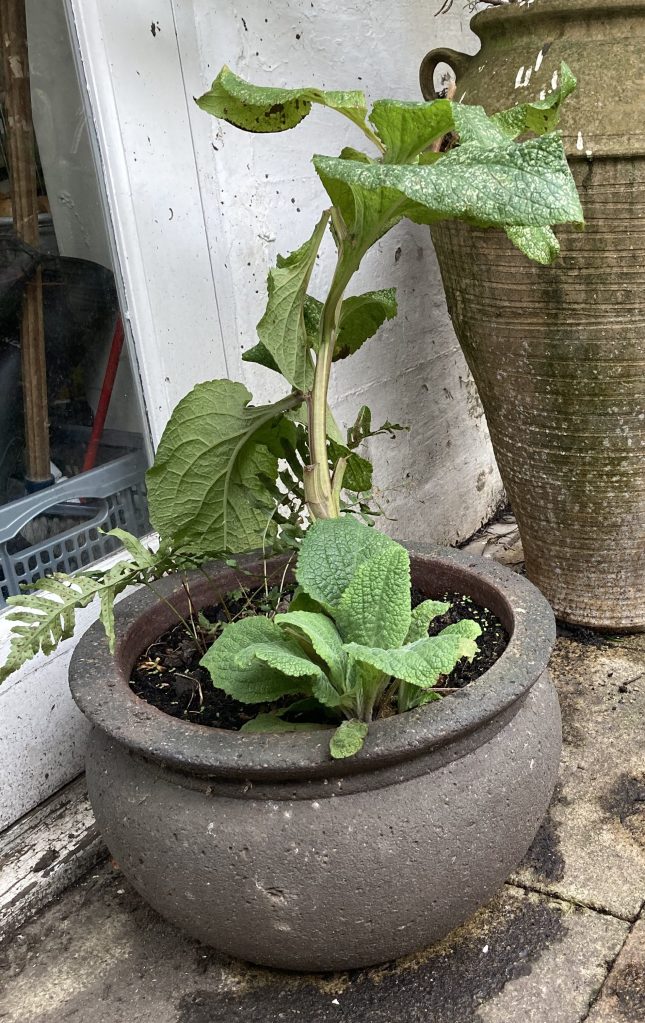
So some of the old spikes have had new spikes (the ones that got cut off cleanly, not just died). And some of them have new green growth but not new spikes. These are the ones in the pot by the door (one of which is at least 2 years old) and a new spike on the one in the left hand bed.
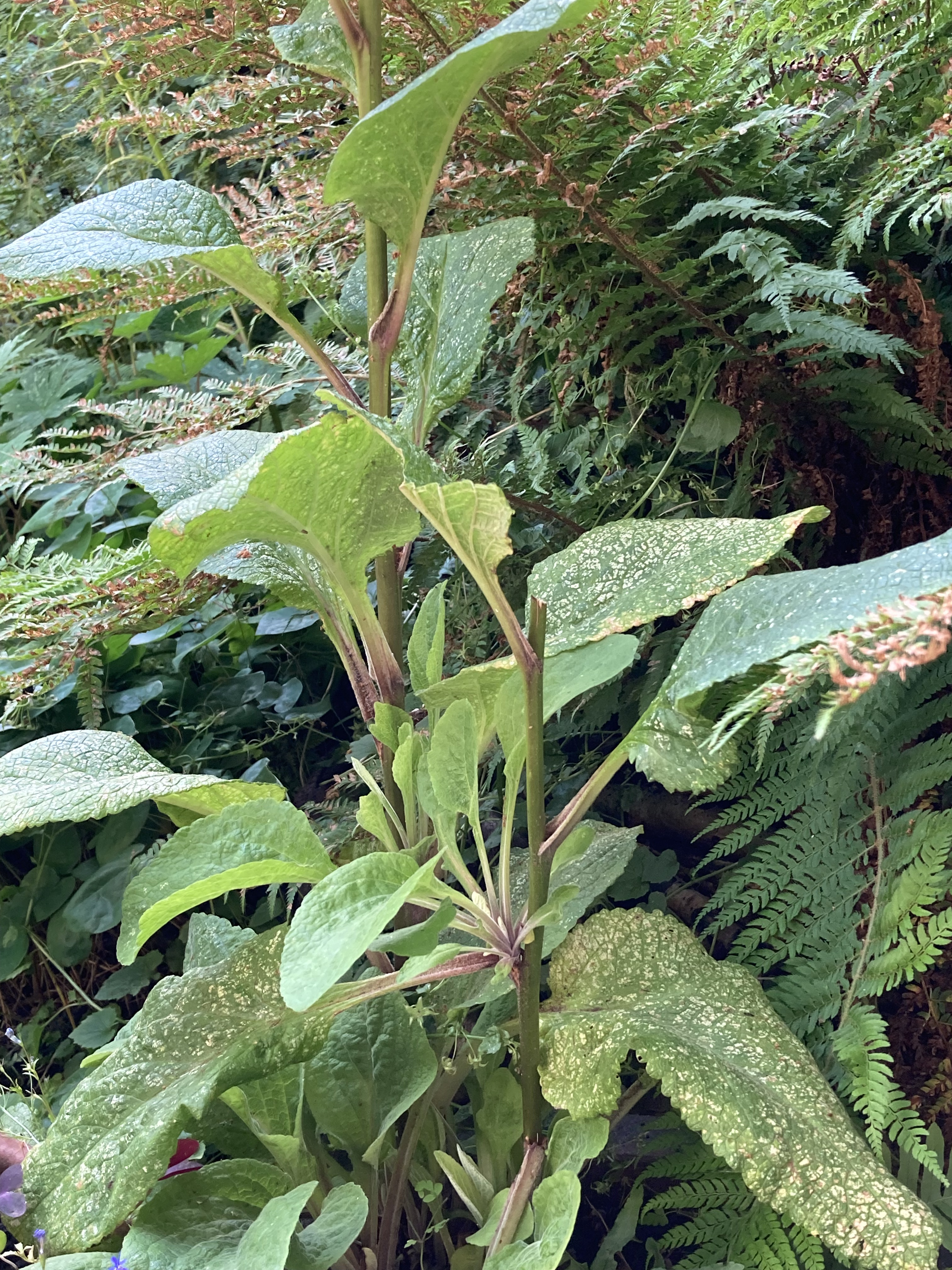
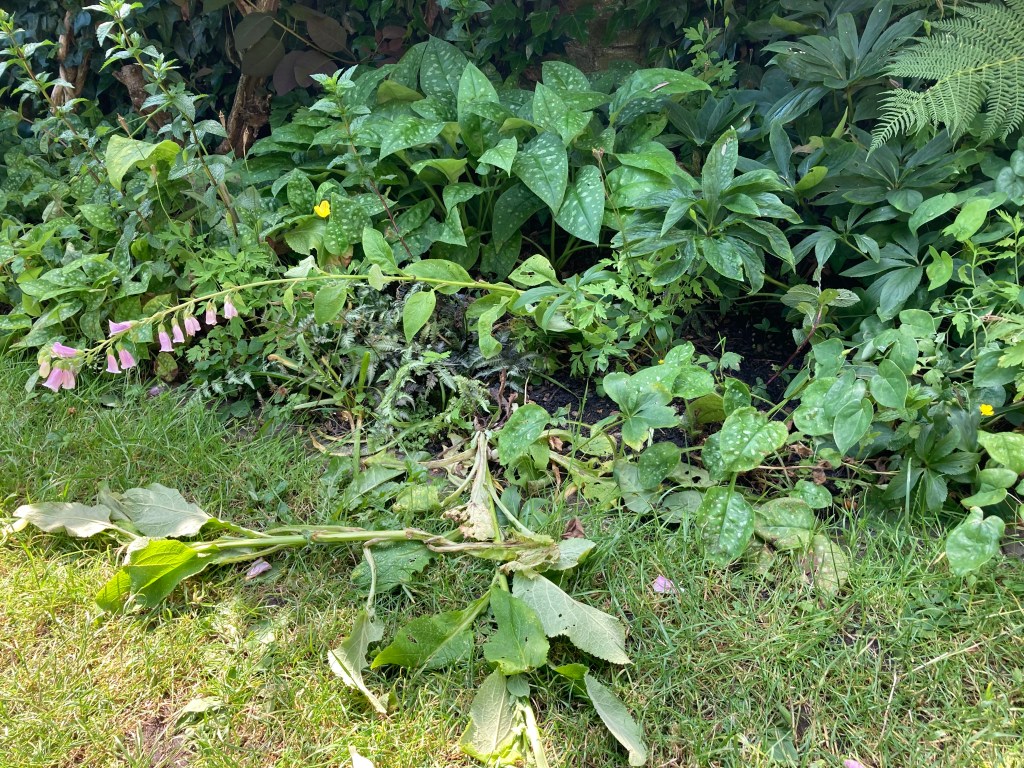
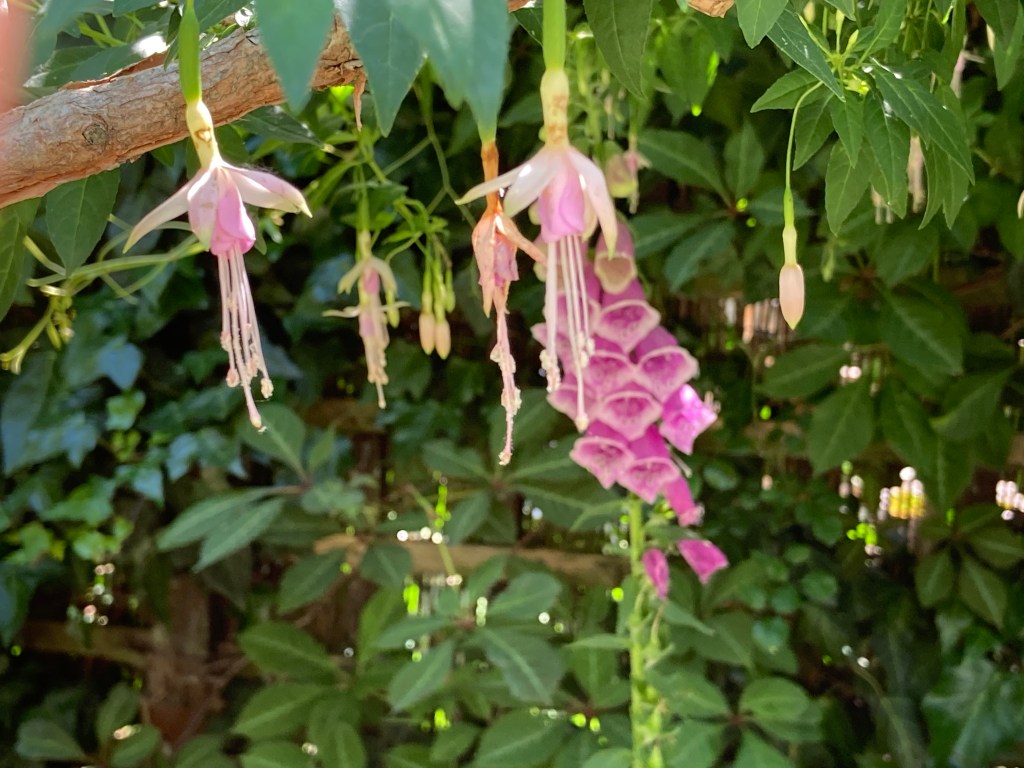
Things I have learnt this year: foxgloves are more complicated than you think. Or more straightforward. If you cut them back, some come again. They might last for several years. They can have lots and lots of spikes at the same time, or a succession. Just because someone smacks them with a cricket ball or a hammock, doesn’t mean it’s over. But somtimes, if you cut them back after flowering, that’s it and they turn into stumps.
I think I’m ready to move onto something else now. Though I have collected and scattered the seed in a slightly more methodical fashion than usual this year, and am interested to see what happens…
Where’s the line between a wildlife garden and a mess? When does it stop being a garden? I guess it’s like the definition of a weed – you decide for yourself. But I’m still finding where my line is.
When we got back from Norfolk, the garden looked terrible. The comparison doesn’t help! But every thing is too big – I have this problem as a lot of things that survived the kids & the neglect have outgrown their space. And there aren’t many flowers in my garden this time of year, and it has been raining so much, the green has shot up. The fuchsia, which mostly I love so much, has bushed out, and put the whole of the back bed in shade. And in this funny stormy light, it looks a horrid salmony pink.
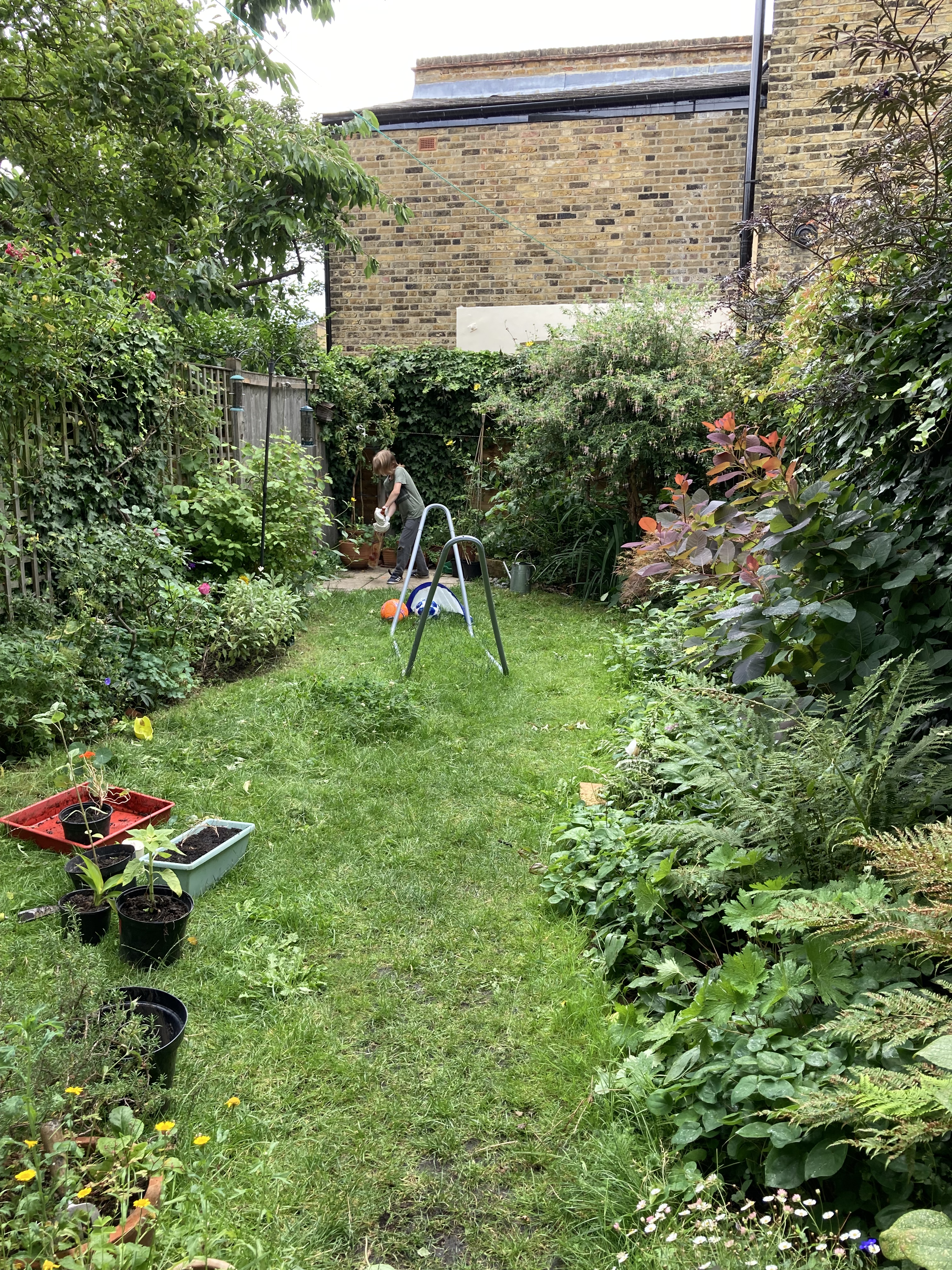
Turning things from a mess to a garden seems mostly to involve cutting stuff right back, tidying stuff up & killing things. I’ve started in this photo, and also cut the edge of the lawn with shears (I will mow the middle). I like the right-hand side more than the left because it’s still wilder….
So I know like it messy, but I think there is still some way to go to make it look like a lovely garden. The trouble is, as soon as you cut things back, you find things living there. Frogs in the grass, caterpillars in the bushes and the fuschia is so full of honey bees, it buzzes. The old dilemma about gardening for wildlife. When do you stop gardening if you really want the wildlife to flourish?
As I am thinking discontentedly what I need to do to this week to rebalance the garden, I should remember… while Chris and I were sitting in the kitchen today after lunch, a BIG beautiful frog hopped across the garden. It sat by the pots for a bit and then it did a massive jump into the cranesbill. That is worth lots of mess!
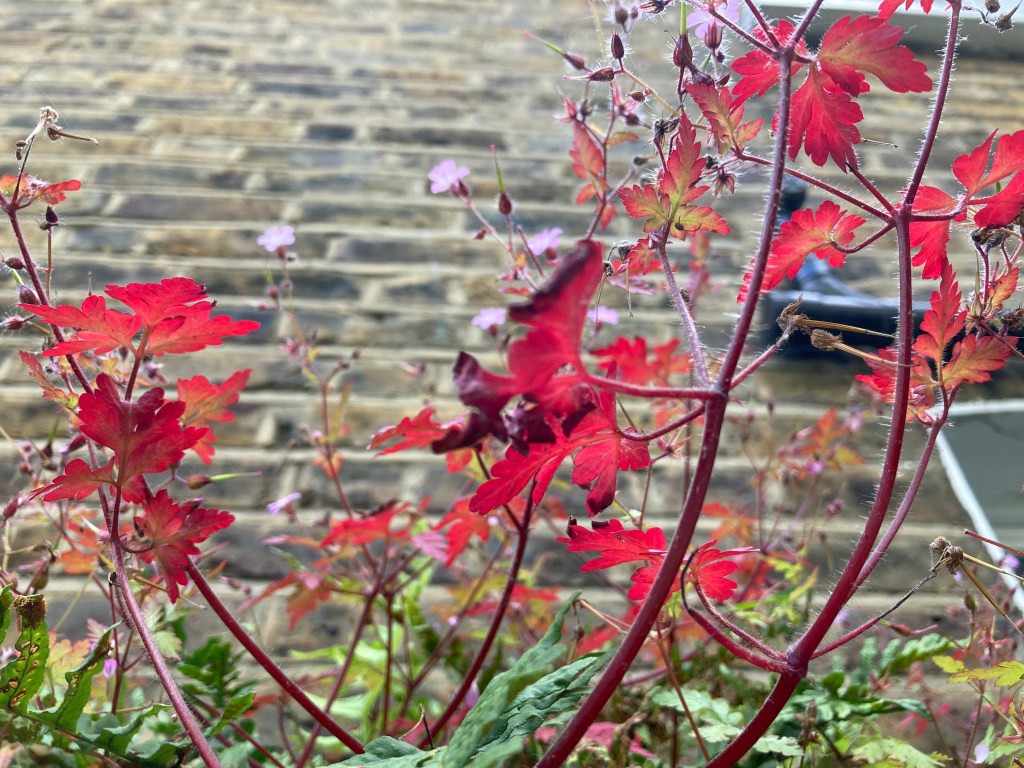
The Herb Robert on top of the shed is bright red. I think it is because it is stressed by shade, but it still sets seed which grows up red the next year. I don’t see why something this beautiful is a weed.
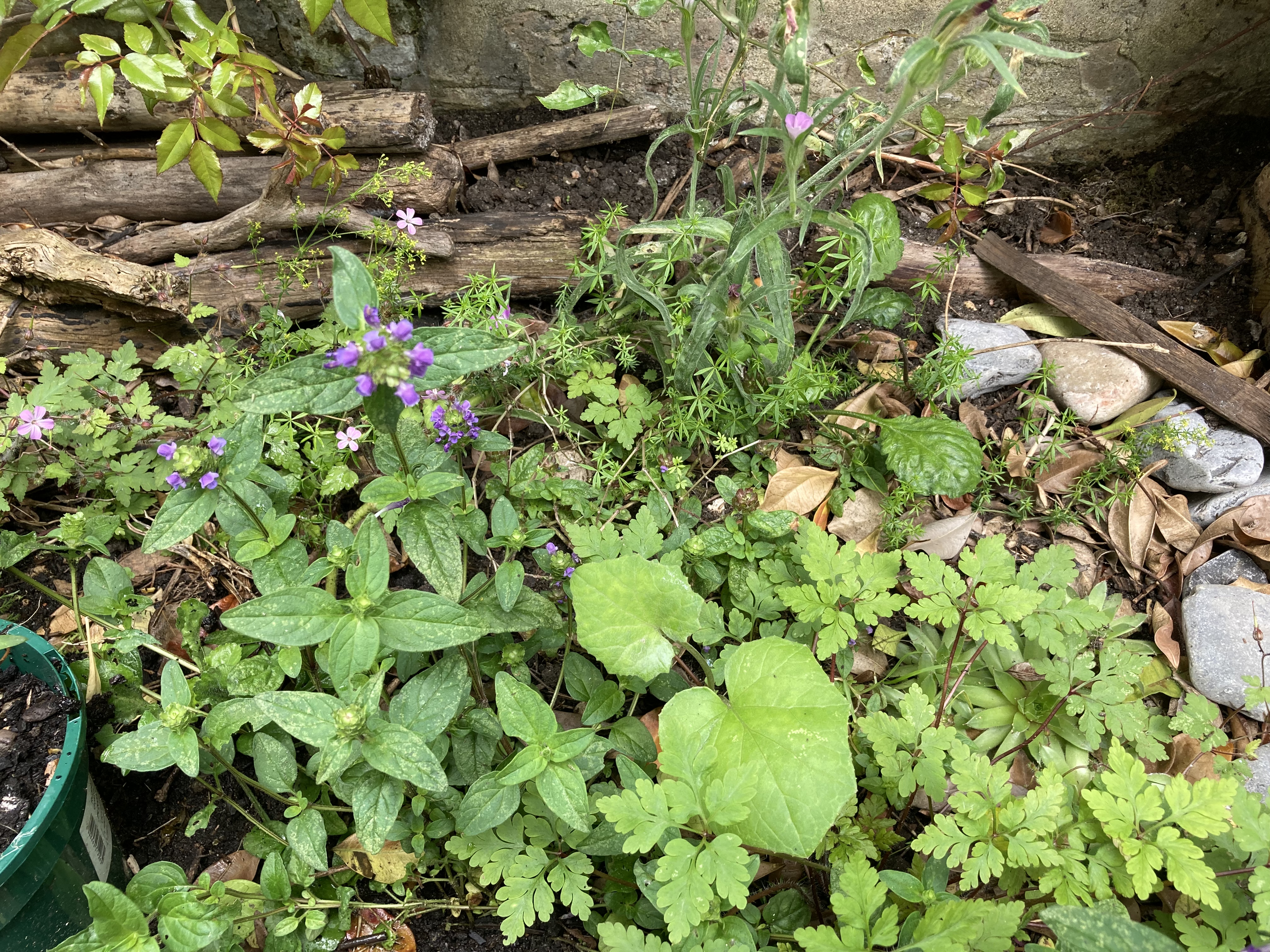
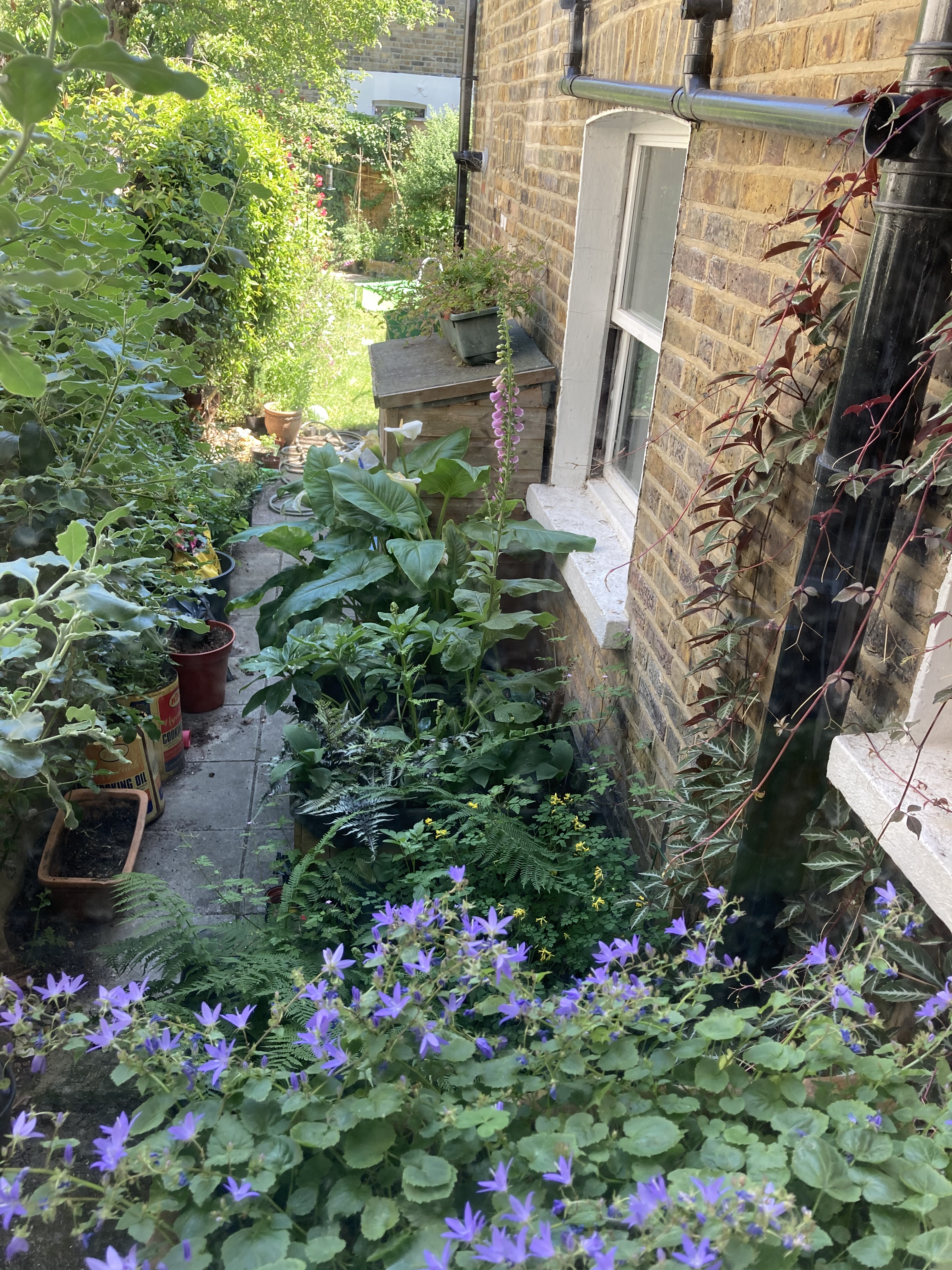
This is a shady, skanky bit of the garden, at the top of the back passage where it meets the main bit. At the moment it is one of my favourite parts of the garden. This is partly because I saw a toad (THE toad?) there the last time I looked and it glowered at me and plodded off.
It’s partly because it’s made out of old bits of weeds that seems to be beautiful and to have come from I-don’t-know-where.
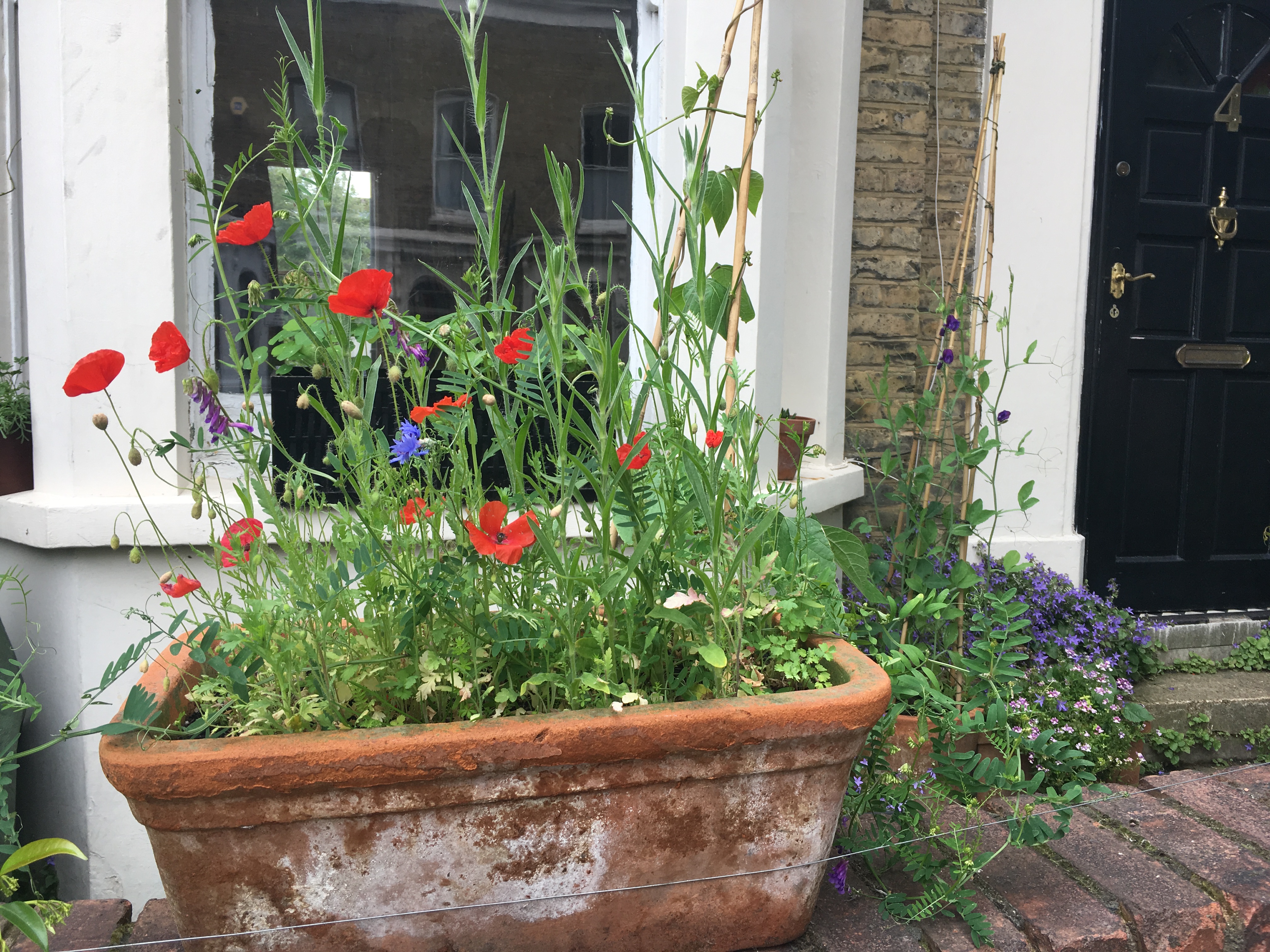
Marion gave me a ceramic bread bin which broke, so I planted it up as a pot. It’s been there for years, and this year, all the cultivated plants had died or got too big. So it just had wild flowers left. I wanted it for the kids for some of the things I got from Core (I LOVE buying things from the Core garden) so I emptied out what was left alive into the skanky bit of the garden and gave it one water and it just got on with it.
I think there is self-heal, and Lady’s bedstraw (or a kind of bedstraw?) and Good King Henry and Herb Robert. And I love it.
Some got rained on so hard they broke; Luke, Ezra and Vincent fell a hammock on a few; Chris’s friend James hit some with his bike (or Chris did) and you always lose a couple to particularly fine cricket shots.
After it rained when I was away, it was very dry for a couple of days, so some appear weirdly to have completely dried out before setting seed (is this a virus or just dryness?).
I wonder what affect this will have on how many foxgloves we have in 2023. Maybe we won’t have any or the ones left will just have more offspring?
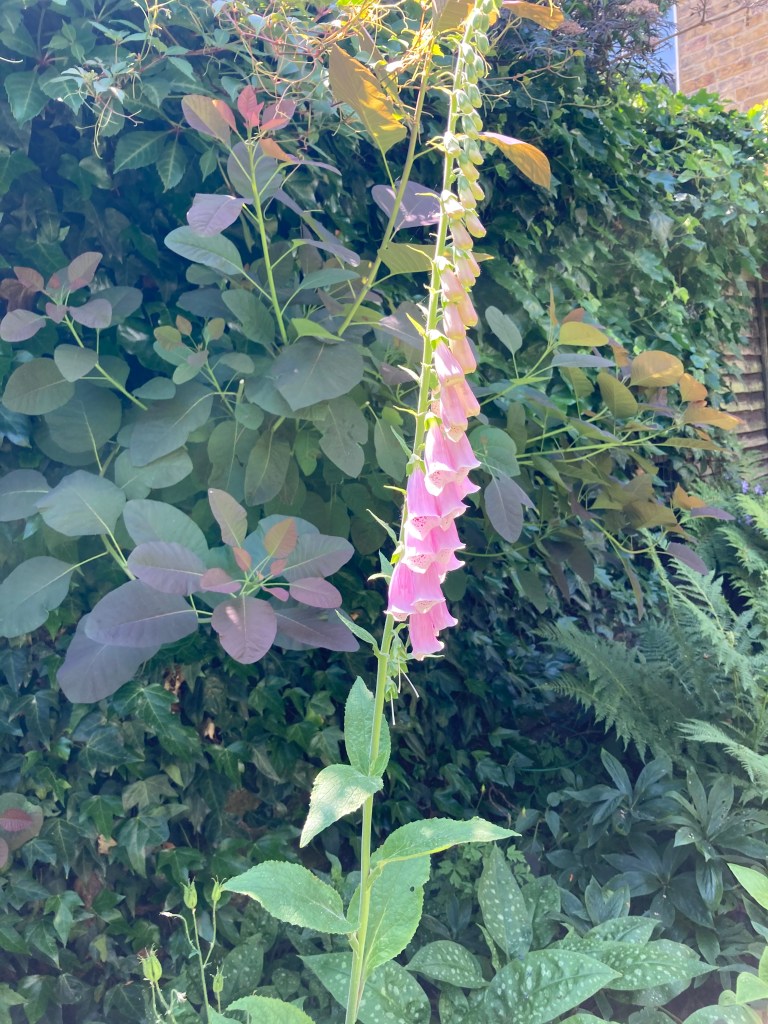
The ones with lots of of spikes are still doing well so I’m putting this picture in again just to make me happy.
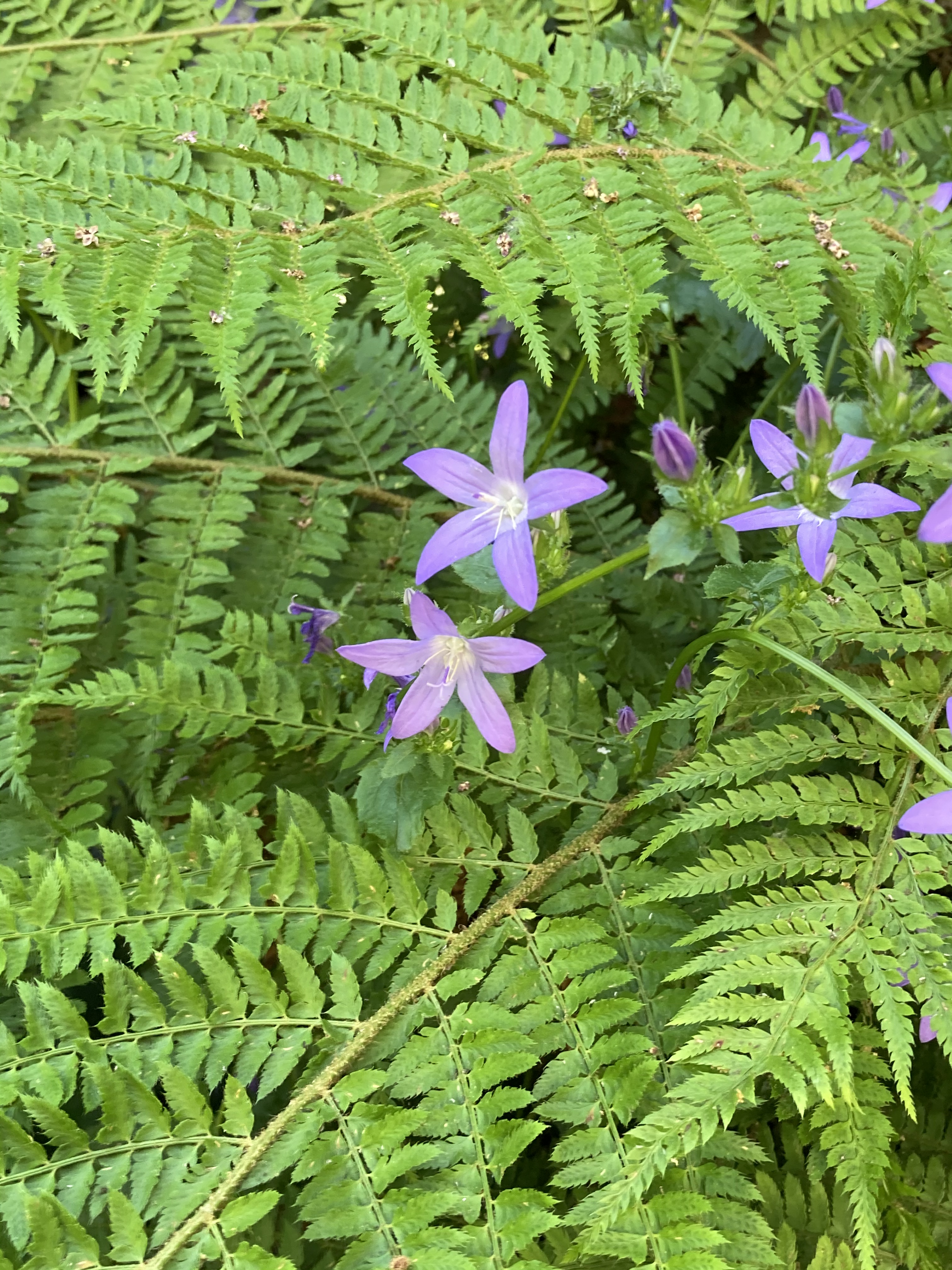
There is campanula growing all round the garden. It’s in the front yard too – and once it even grew up through the floorboards in the sitting room.
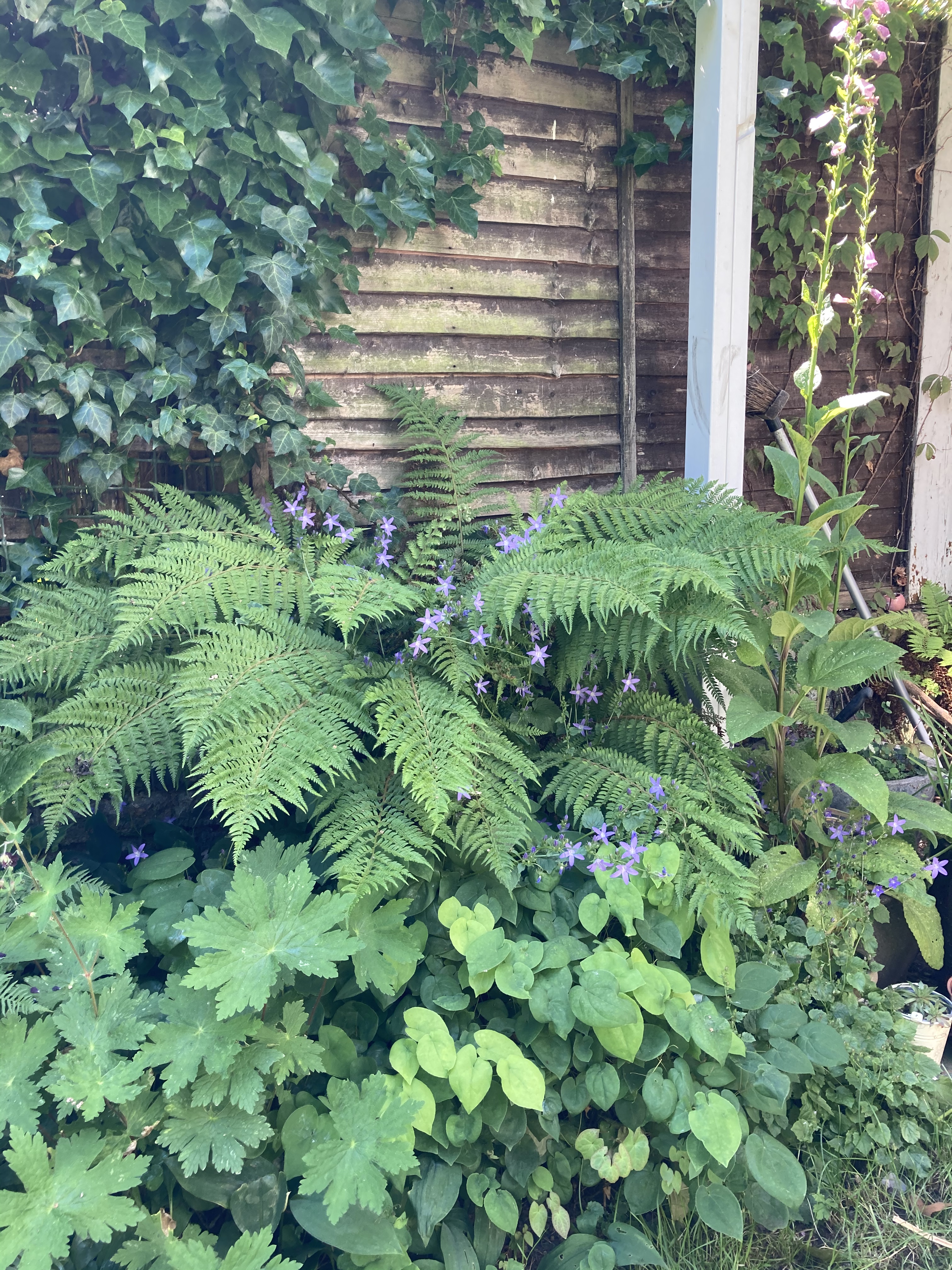
This year, it is looking very lovely growing up through the fern by the backdoor. It’s never done this before but has put up long flowers through the foliage.
This is a window box full of it too. This used to be planted with bedding plants but the campanula crept in and took over.
PS these are very beautiful dark bits of the garden – shady corner and back passage
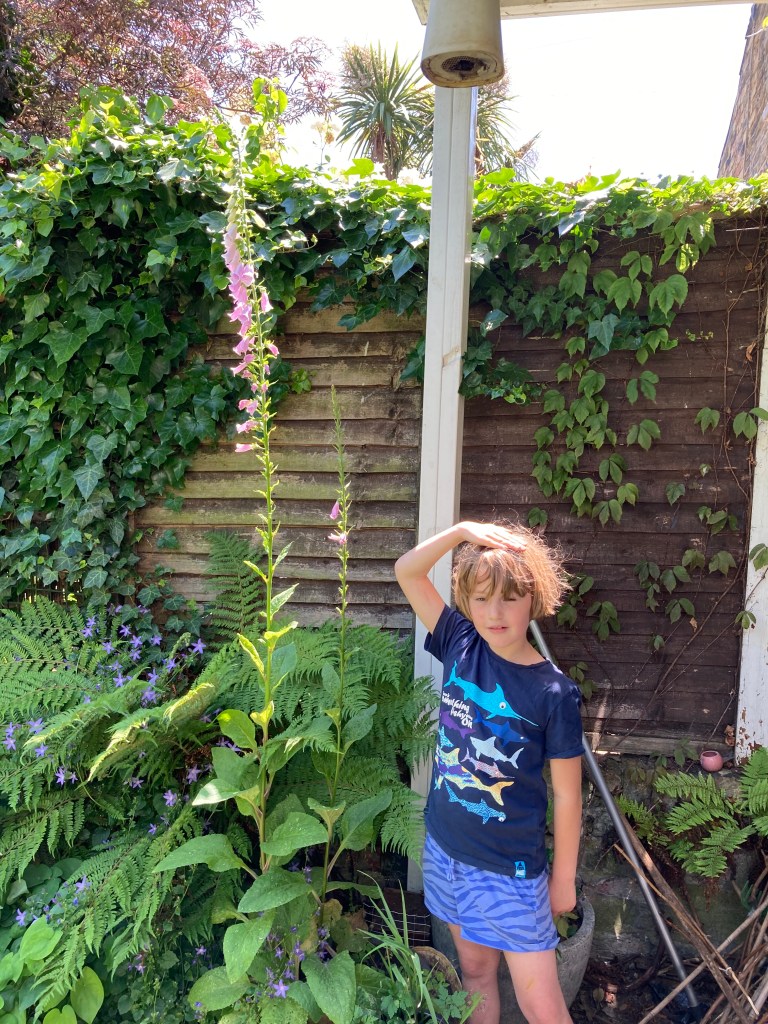
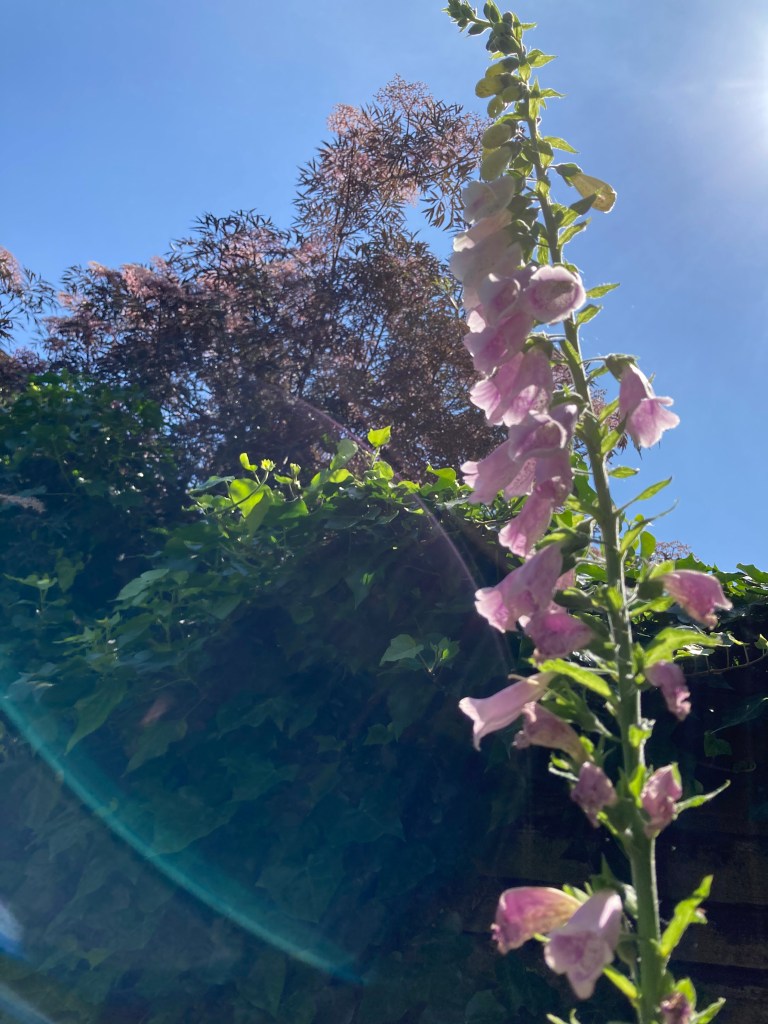
The fox gloves are doing well. We’ve got about 14, white and purple. Some of them have been hit by hammocks and footballs and aren’t doing brilliantly. But some have grown other spikes, when the king spike got taken out. And others are just thriving, though they don’t like the really hot weather.
We can’t work out where all the foxgloves in this post are. But we have found this one:
how it started
how it’s going!
Edie shown for reference. She’s about 4 feet high. Both spikes have flowered but we don’t know which is the biggest, the old or the new.
I particularly like this one, with lots going on in one pot.
Like lots of people, I am taking part in No Mow May Just writing it makes me HAH! like Patty and Selma.
We’ve been heading towards not mowing for a while. On a lot of the lawn, we don’t have grass anyway so it’s not like we have a green sward. We let it grow last May, and at the end of the month, me and the kids measured out our square metre like you’re supposed to and found we had enough flowers to keep one bee alive for about 10 minutes.
This year, we have more things. Maybe because it’s not as hot. Maybe because we let it grow last year. But all the things we have are either dandelions or things that have escaped from the beds (eg; lily of the valley).
And it makes me cross that all the pics (see on No Mow May link above!) are all beautiful meadows and orchids and rare grasshoppers and how you can cut a path through it like a swathe. You can’t do that in a small suburban garden. Actually, I have tried and it doesn’t look bad but STILL…
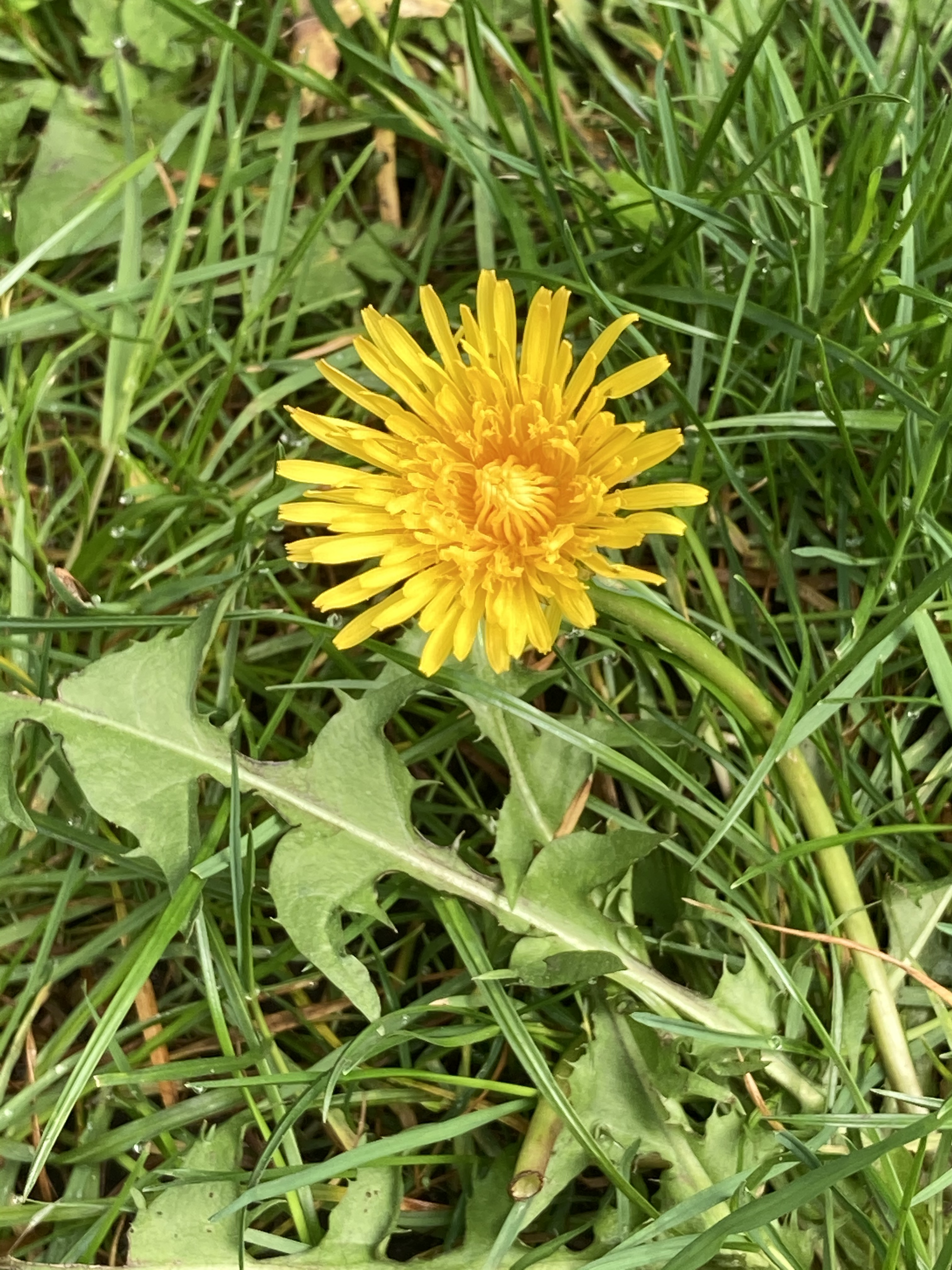
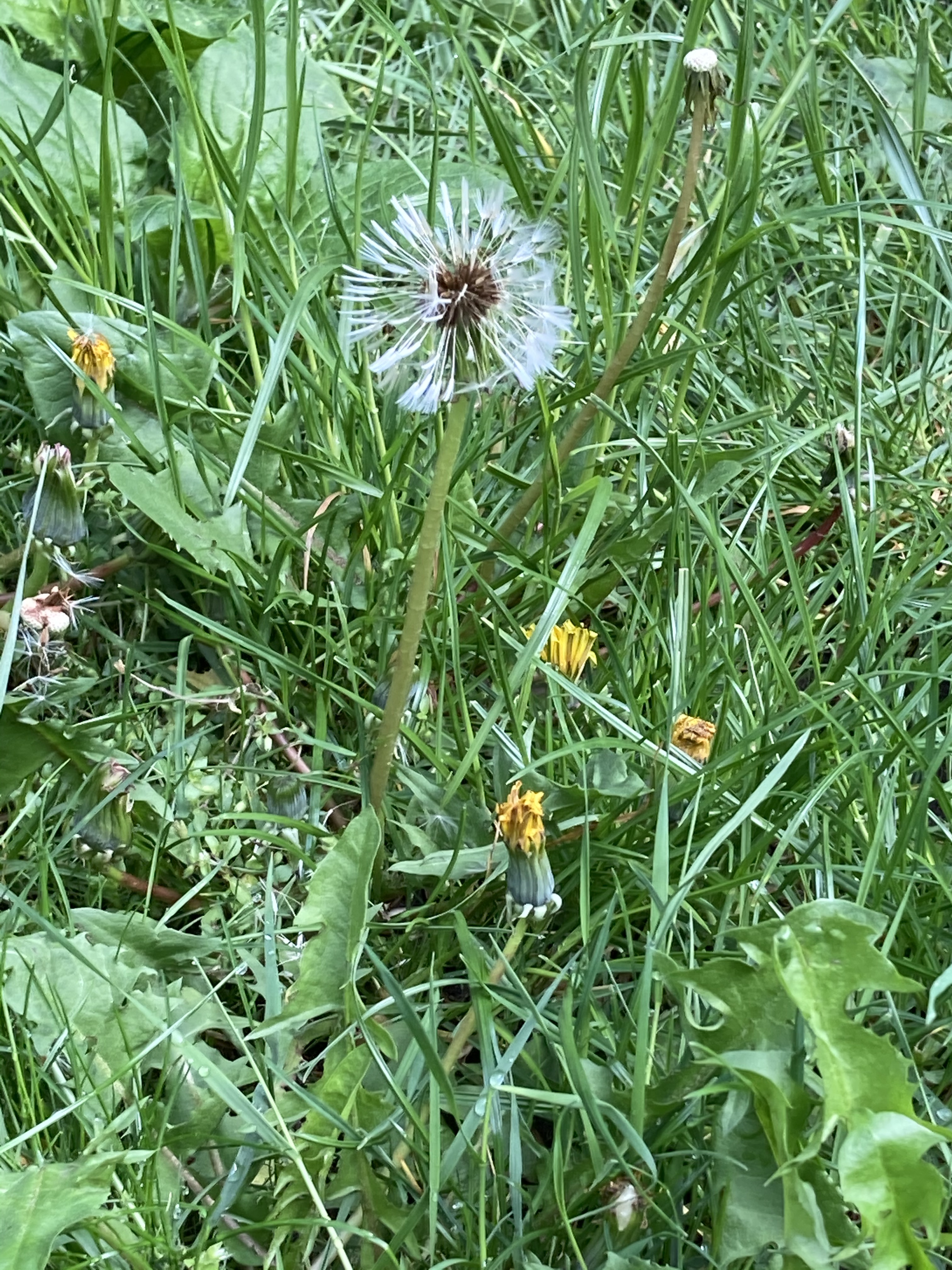
Also, I am struggling with dandelions. I know I should love them but I don’t. I am prejudiced against them. I have shifted how I see wild flowers. I don’t see weeds. I see beauty and delicacy and tenacity. But I still feel old-fashioned about dandelions. They ARE WEEDS! I understand how most people still see wild flowers when I look at dandelions! They smell horrible, they are deep-rooted bullies and take over all the grass. I know they make bees and hoverflies happy but I just don’t like them. We have more this year and they are a bit better growing in drifts, but STILL….
ps: we DO have grasshoppers (we’ve seen their legs sticking out of the bug hotel when something is eating them) and mining bees that live in the sandy patches so obviously our scabby lawn is rich (-ish) environment but STILL…
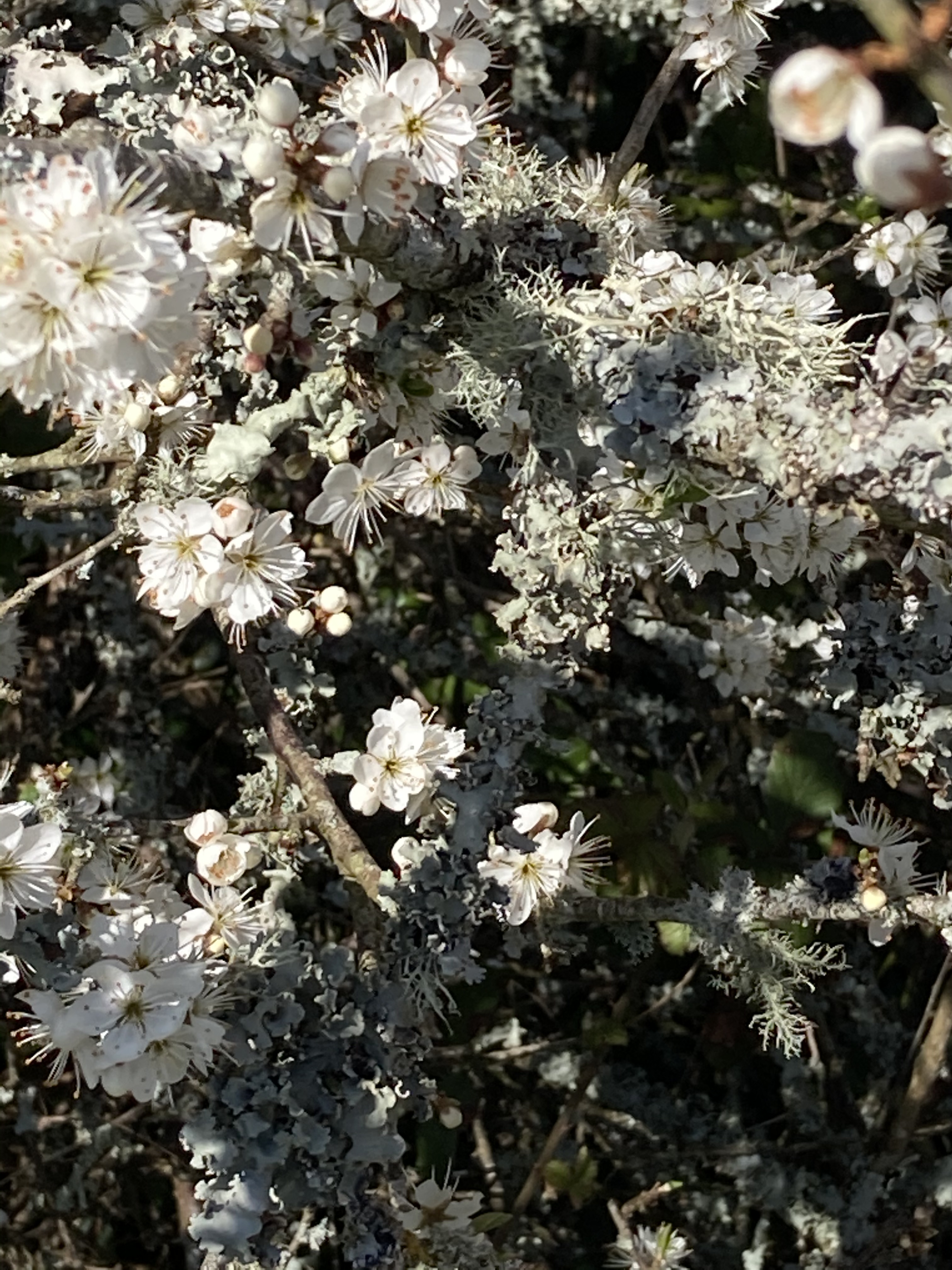
I do. I started looking at the lichen round A&A’s house – and bought a book about it. It’s a very curious plant. I’ve got some growing on the fuchsia. This is some I saw up on Penlee Battery in Cawsand though, blossom and lichen at once.
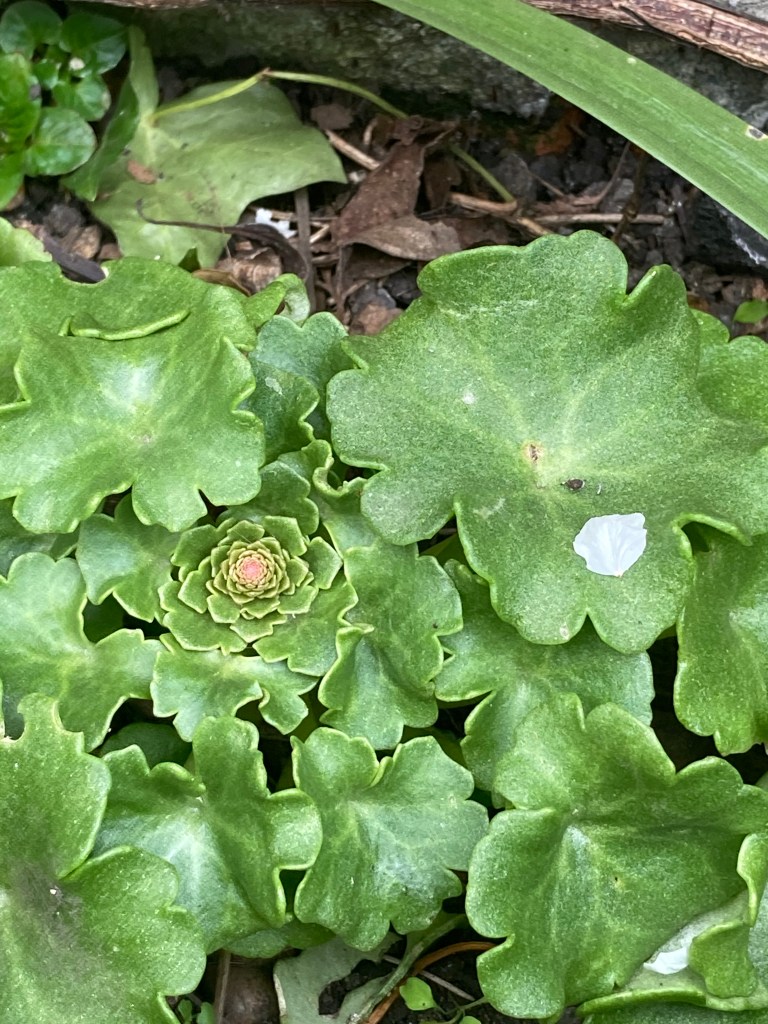
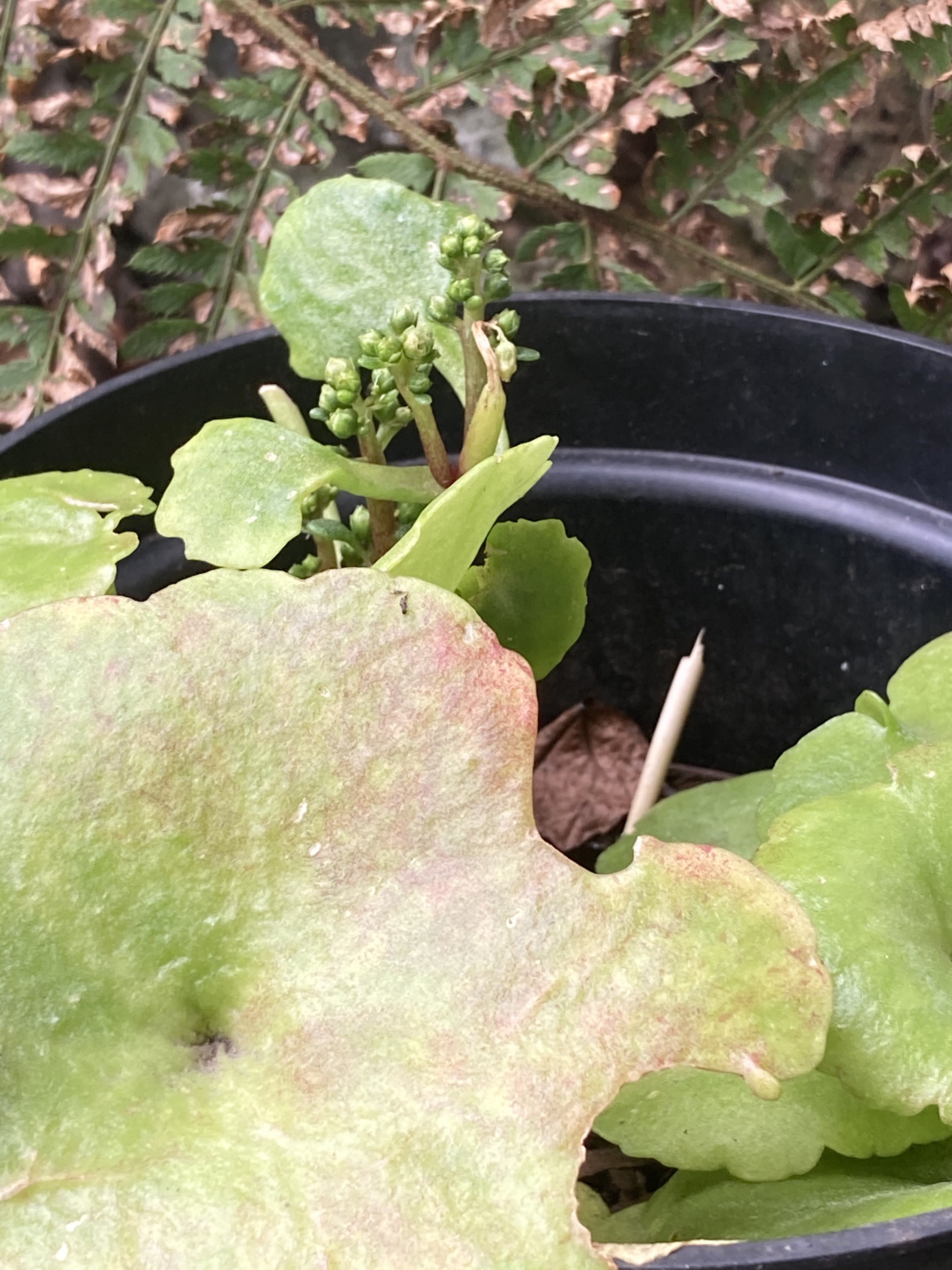
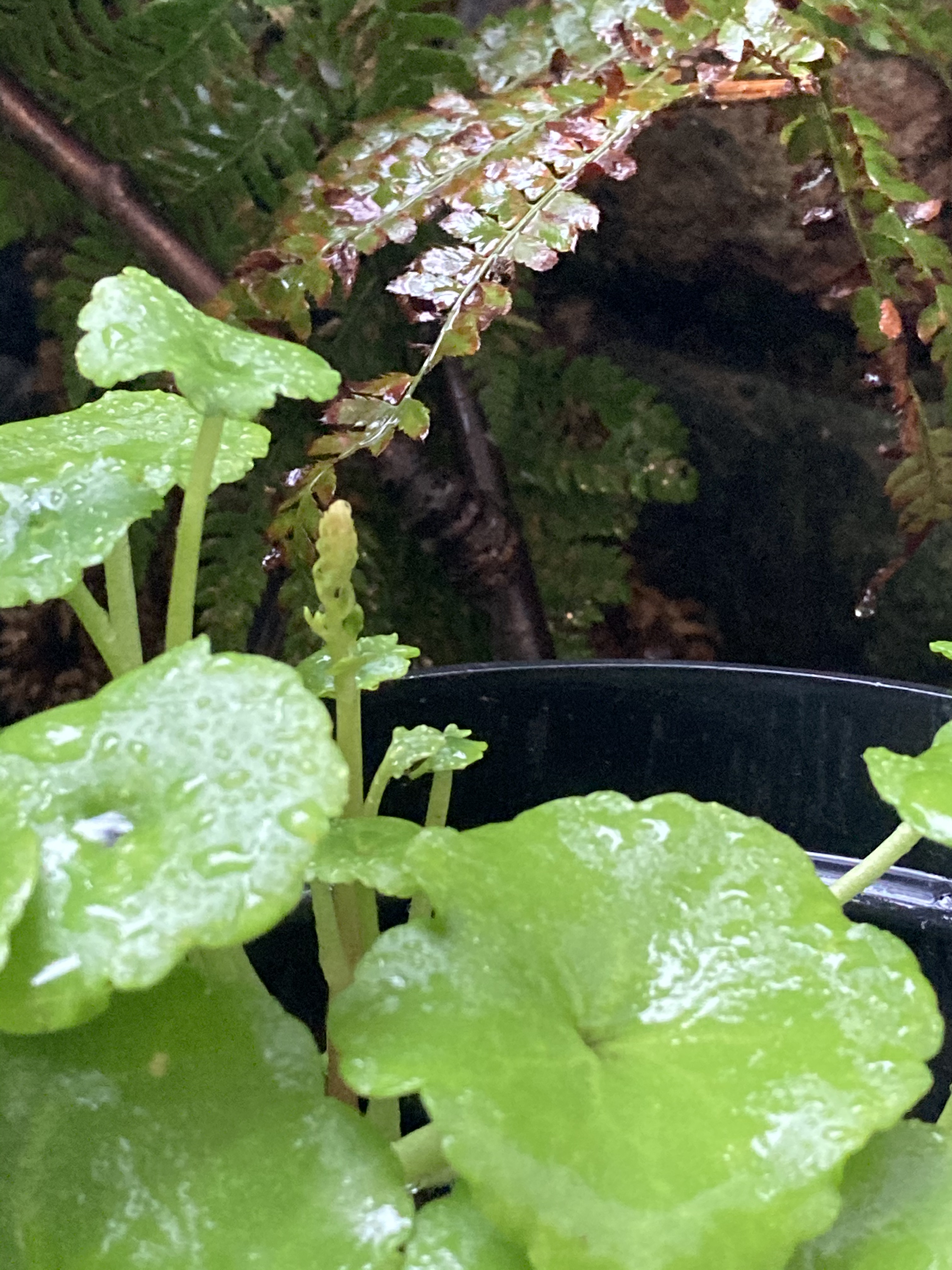
I never would have thought I would post more about navelwort than anything else. But here it is. These are the two in my garden. I thought they were the same plant, and then I thought maybe one was the male and one female. Now I wonder if they are different plants altogether?
I saw a lot like this in Cawsand – some with rosettes that grow into spikes and some with just spikes. Spiky one looks a bit sad TBH
It’s hard to know if gardening for wildlife is making a difference to the wildlife in my garden. I know it makes me happy, but does it work for the wildlife?
I don’t know if we have more bees, bugs & insects. I think we do but I didn’t look for them before so I don’t know. I know we have fewer birds (we used to have blackbirds, dunnocks, wrens, more robins, lots more blue tits) but I think that’s probably cats and gentrification.
I think my garden is so small, it’s hard to see if it makes a difference on its own. So many external factors affect it. I don’t have the skills and patience to do in-depth bug counts like that lady in Sheffield. But I guess part of the point of recording it here, is to see long term if stuff works.
Today it was sunny for the first time for ages. There were hairy footed flower bees (finally)) and lots of different hoverfies (I have hoverfly lagoon in the back passage); and maybe small wasps, a cabbage white and a speckled brown (which I’ve never seen before). The tadpoles are hatching, and the 4 birds that do visit are eating from the plants not just the bird feeder, and the “waste” I didn’t clear off the beds but left to rot down looks like it’s turned into flowers. So today feels like a good day!
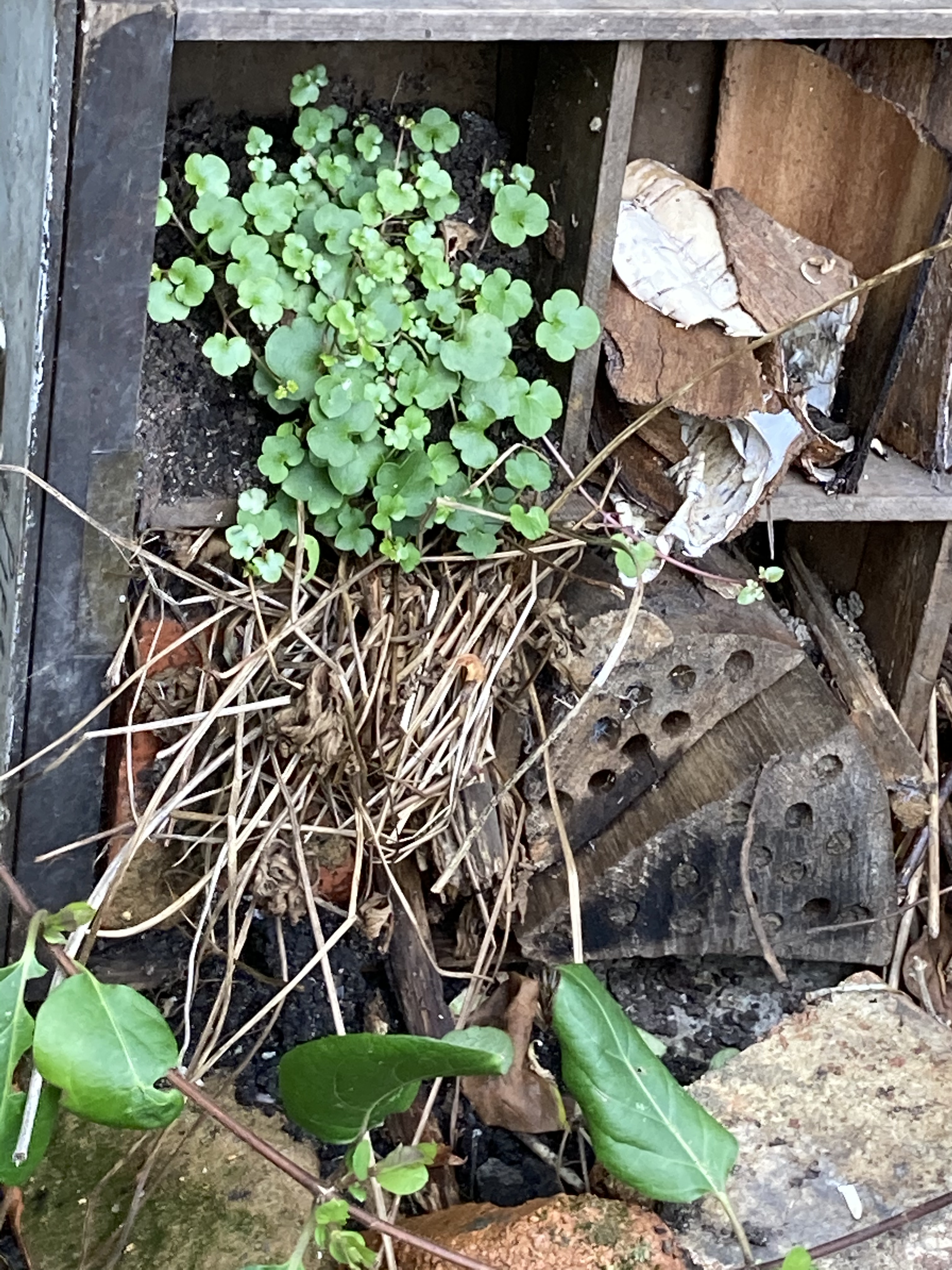
How can this have such an ugly name? It’s also called cymbalaria muralis so I might call it that instead. I took it from the steps of my parents house in Cornwall when I swiped the Navelwort and I hoping it will spread too. Here it is in old box (where I think a very small toad was hanging out last year… !)
It’s got a flower spike! This has got to be the wrong time? It is very sheltered as it’s under the roof terrace but still gets some light, but it can’t be warmer here than in Cornwall? Let’s see what happens…
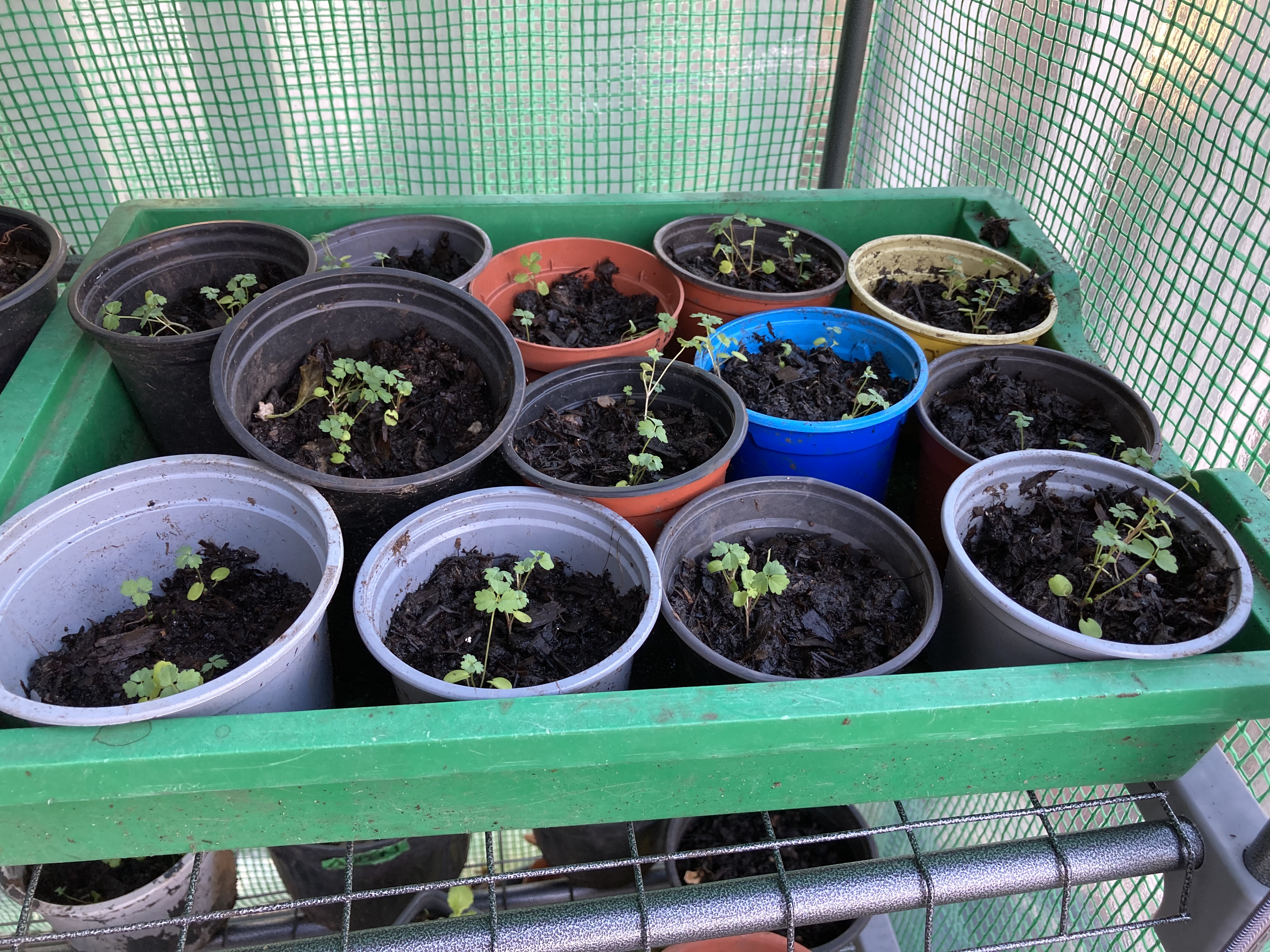
I am growing Salad Burnet! Who knew? I thought it was something else.
The first wildflowers seed mix had some and they were prolific(!) in the Other Garden and were the most lovely plant. I took the seeds and sowed them in a drawer and they came up (I think that’s them). Lessons
1 Label stuff
2 If you cut SB back, it comes again. The flowers are really beautiful.
3. Apparently you can use it in salad and it tastes of cucumber according to the Woodland Trust
4. I potted it on 27th December!. The drawer I planted them in was quite shallow and the roots were very widely spread. If you scooped straight down with a spoon, that still didn’t get them. Maybe this is true of a lot of wild plants that grow in places that aren’t very rich – they spread a lot.
QUESTION: how will they adapt to better soil? The soil in the Other Garden is very poor because it’s under a tree and no-one has fed it for decades. How will they do in my richer garden? Maybe plant some in pots and some in old crap soil
6, QUESTION: how good is the soil in MY garden? (and does it matter/ is it better if it’s not great?)








 My Garden